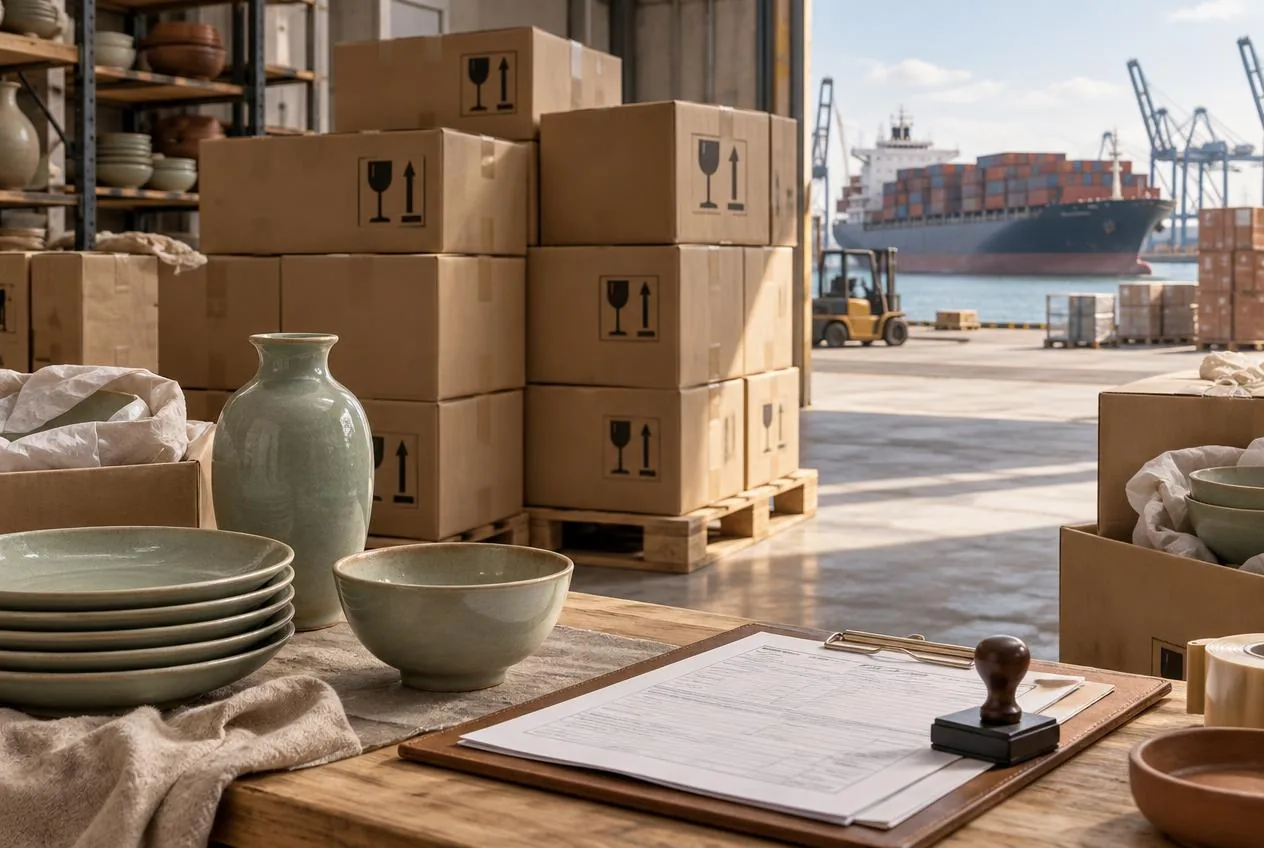
The United States has no anti-dumping or countervailing duty orders on Chinese ceramic tableware under HS 6911 and 6912, as of our September 2026 review of public case listings. What US-bound buyers face instead is a Section 301 duty of 25% on most tableware codes, additional tariff layers added since 2025, and the closure of the de minimis exemption in August 2025. This guide maps the full stack and shows how to verify it before you sign anything.
The baseline: no AD/CVD orders on ceramic tableware
A search of public trade-remedy sources — the Federal Register and the official AD/CVD case databases — found no anti-dumping or countervailing duty order in effect against Chinese ceramic tableware under HTS 6911.10 or 6912.00 as of the September 2026 retrieval. Two neighboring cases cause most of the confusion, and neither covers your products:
| Case area | Product actually covered | Status |
|---|---|---|
| Porcelain-on-steel cooking ware (case A-570-833) | Composite enamel-on-steel cookware, not ceramic tableware | AD order continued through its fifth expiry review in October 2021 |
| Ceramic tile (HTS 6907/6908) | Construction tile — a different industry entirely | AD/CVD orders in effect since June 2020 |
Because new petitions can be filed at any time, treat "no order today" as a status report rather than a permanent condition: verify the case database before contracting, and again before each reorder cycle.
The Section 301 layer: List 3 at 25 percent
Most 8-digit tariff lines under 6911.10 and 6912.00 sit on List 3 of the Section 301 action — the USD 200 billion tranche — where the 25% rate has applied since 10 May 2019. Exclusion windows for various lines were extended and reshuffled repeatedly through 2025, which is why outdated blog posts still quote lower or zero rates for tableware lines that lost their exclusions long ago. The 25% List 3 layer is the one stable, well-documented component of the China duty stack for ceramics.
The layers stacked on top since 2025
From 2025, additional tariff actions — IEEPA-based measures and reciprocal-tariff actions — added further percentage layers on China-origin goods. The combined rate for any given 10-digit code therefore moves frequently, and no single published figure stays current for long. The working discipline is unglamorous but effective:
- Pin the exact 10-digit HTS code for each SKU (porcelain in the 6911.10 family, other ceramics in the 6912.00 family).
- Check the official HTS with its Chapter 99 annotations for the cumulative rate.
- Date-stamp the screenshot or printout and attach it to the quotation file.
- Repeat at every reorder — not every year, every order.
The de minimis closure completes the stack
Executive Order 14324, signed on 30 July 2025, suspended duty-free de minimis treatment for all countries effective 29 August 2025; Executive Order 14388 of 20 February 2026 continued the suspension. Postal shipments now face temporary per-item duties in tiers of $80, $160 and $200 depending on origin, and commercial parcels require formal entries with duty paid. For ceramics sellers, this ended the low-value direct-post model that much of the dropshipping industry was built on.
An illustrative duty stack on a $10,000 order
The numbers below are illustrative — they show the shape of the calculation, not a quote. Confirm the dutiable-value basis and the current layer rates with your customs broker before relying on any total.
| Line | Basis | Illustrative amount |
|---|---|---|
| FOB goods value | Contract price | USD 10,000 |
| Section 301, List 3 | 25% | USD 2,500 |
| Reciprocal / IEEPA layers | Variable by code and by policy action | Verify per 10-digit code at time of entry |
| Entry fees and brokerage | Broker schedule | Quoted per shipment |
Even with the variable layers left open, the fixed 301 component alone adds a quarter of the goods value. That is why US pricing models built on "duty is minor for tableware" assumptions from the 2010s no longer describe reality.
Why DDP became the working answer for US-bound ceramics
With formal entries now mandatory for parcels of any value and multiple tariff layers in play, many buyers prefer that the party shipping daily also owns the customs process. Under DDP, duty is prepaid at entry and the quotation shows one landed number; the buyer avoids broker onboarding, bond arrangements and per-shipment rate research. The trade-off is trust: a DDP quote is only as honest as its duty line, so ask that the applicable instruments and rates be named — the same discipline we apply across our tariff planning guidance.
Food-contact compliance runs in parallel to tariffs: ceramic dinnerware entering the US is subject to FDA lead and cadmium action levels under 21 CFR 109.16. Have test documentation ready before the first entry — see the compliance overview for the limits and test methods.
Frequently asked questions
Is there an anti-dumping duty on Chinese ceramic dinnerware in the US?+
No AD/CVD order was in effect on Chinese ceramic tableware under HTS 6911 or 6912 as of our September 2026 retrieval of public case listings. This is a snapshot, not a permanent fact — verify the official case database before contracting.
What is the total duty rate on HS 6912.00 from China right now?+
The stable layer is Section 301 List 3 at 25%, with additional 2025-onward layers whose rates change frequently. There is no honest single number that stays current — verify the cumulative rate for your exact 10-digit code on the official HTS before quoting or signing.
Do porcelain and stoneware enter at different US rates?+
Both headings carry the Section 301 layers, and the US has no AD/CVD order on either as of our review. Classification still matters for base rates, statistics and any future product-specific action, so keep 6911 versus 6912 distinct on every document.
Are samples under $800 still duty-free?+
No. The de minimis exemption was suspended effective 29 August 2025, so even sample parcels clear with duty paid. For the operating consequences, see our guide to the de minimis removal and the US market page.
To price US-bound ceramics without guessing at the duty line, request a DDP landed-cost quote with the tariff layers named.