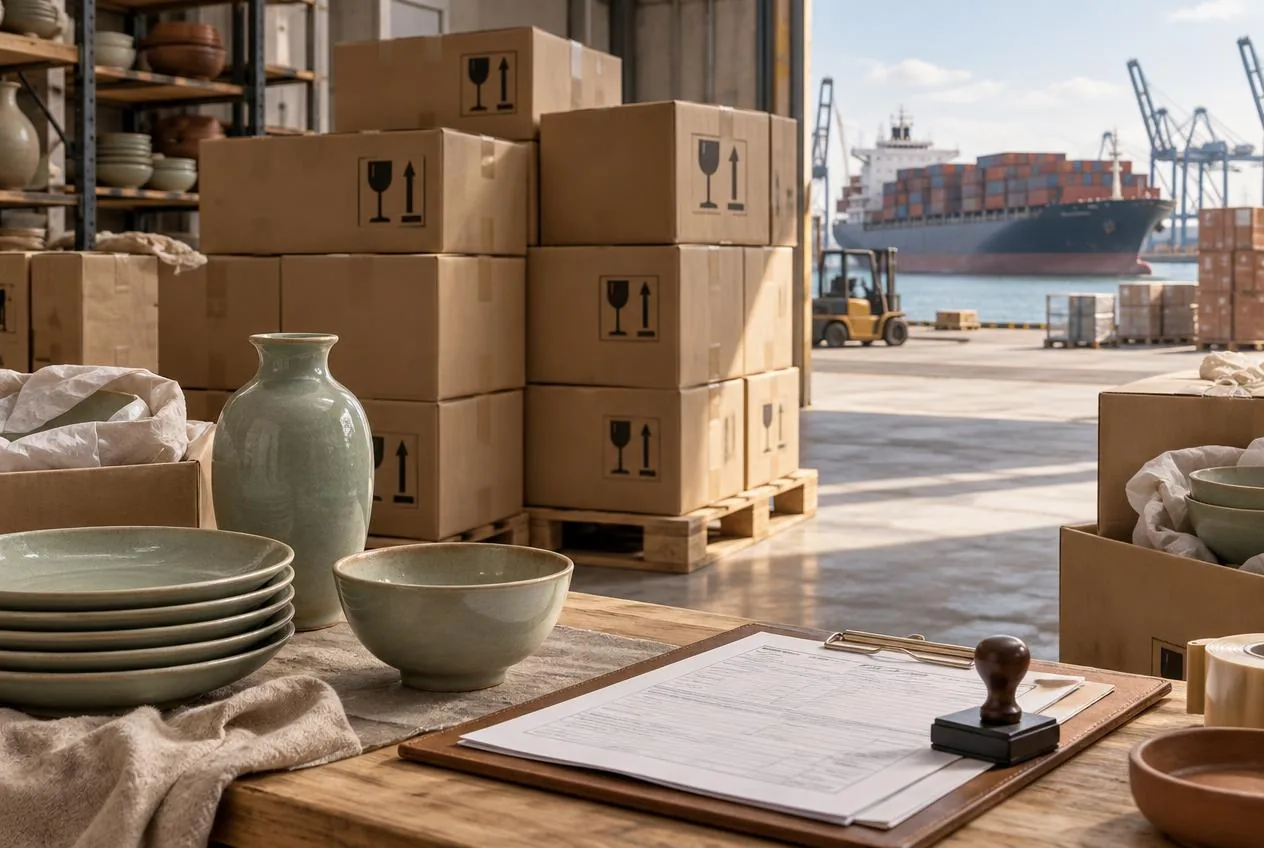
Since 7 February 2026, Chinese ceramic tableware entering the European Union carries a single anti-dumping duty of 79.0 percent, replacing the company-specific range of 13.1–36.1 percent that had applied since 2013. This guide explains what the measure covers, how the rate escalated, and what EU-bound buyers should now change in quotations, contracts and landed-cost models. It is written for importers, ecommerce brands and hospitality procurement teams sourcing dinnerware and teaware from China.
The duty is not a tariff-line adjustment. It is a trade-remedy measure — an anti-dumping duty — imposed on a product category regardless of which Chinese factory produced the goods. That distinction matters commercially: you cannot shop around for a supplier with a lower rate, because after the February 2026 interim review there are no lower rates left to find.
What the 79.0 percent duty covers
The measure applies to ceramic tableware and kitchenware originating in China, spanning both porcelain or china wares (HS 6911) and other ceramic wares such as stoneware (HS 6912). In practice that captures nearly everything buyers source from Chinese kilns — dinner sets, plates, bowls, mugs, teapots and serving pieces. Bone china falls under the porcelain heading and is equally in scope.
| Typically in scope | Outside this measure (classify and verify separately) |
|---|---|
| Porcelain dinnerware sets, plates and bowls (HS 6911) | Ornamental figurines and decorative giftware (different heading) |
| Stoneware plates, bowls and oven-to-table pieces (HS 6912) | Ceramic tiles and construction ceramics |
| Porcelain and ceramic mugs, cups, teapots and servers | Non-ceramic serveware such as glass or melamine |
Border disputes usually arise at the edges — decorative pieces sold alongside dinnerware, or mixed gift sets containing non-ceramic components. Confirm the commodity code with your customs broker before the commercial invoice is issued, not after the goods arrive.
How the rate evolved: 2013 to 2026
Buyers who quoted EU business before 2026 were working with a structure that varied by named producer, from 13.1% at the low end to a residual 36.1% for everyone else. The jump to a single rate happened in two steps within five months.
| Date | Event | Instrument |
|---|---|---|
| 2013 | Original definitive anti-dumping duties on Chinese ceramic tableware and kitchenware at company-specific rates of 13.1–36.1% | Original 2013 measures |
| 2019 | First expiry review: duties continued; later amended so goods routed through circumvention channels paid the residual 36.1% rate | Implementing Regulation (EU) 2019/1198, as amended by (EU) 2019/2131 |
| 7 October 2025 | Second expiry review concluded: duties continued at 13.1–36.1% | Implementing Regulation (EU) 2025/1981 |
| 5 February 2026 | Interim review concluded: all company-specific rates withdrawn; a single 79.0% duty set for all Chinese producers and exporters | Commission Implementing Regulation (EU) 2026/274 |
| 7 February 2026 | (EU) 2026/274 enters into force; the 79.0% rate applies to goods released into free circulation from this date | (EU) 2026/274 |
| September 2026 | The 79.0% measure is under legal challenge; proceedings were pending at the time of our review | — |
What the duty does to an EU landed cost
Anti-dumping duty is charged as a percentage of the customs value of the goods — for the illustration below, a CIF value of EUR 10,000. The comparison shows why quoting models built before February 2026 no longer hold.
| Cost line (illustrative) | Until 6 Feb 2026 (example: 17.9% rate) | From 7 Feb 2026 |
|---|---|---|
| CIF customs value | EUR 10,000 | EUR 10,000 |
| Anti-dumping duty | EUR 1,790 | EUR 7,900 |
| Import VAT | Charged by the member state on the duty-paid value; the rate varies by country | |
| Clearance and brokerage | Quoted by your customs representative | |
An order that carried roughly EUR 1,800 in anti-dumping duty in January 2026 carried EUR 7,900 from 7 February — a gap of more than EUR 6,000 on a EUR 10,000 shipment, before VAT and fees.
Why the EU moved to a single rate
The interim review replaced differentiated company rates with one country-wide rate, and two consequences follow for buyers. First, supplier selection no longer moves the duty line: a rate that once ranged from 13.1% to 36.1% across factories is now uniform, so the old advice to "find a named company with a low rate" is dead. Second, because the measure is under legal challenge, the duty position can evolve; contracts signed today should anticipate review outcomes rather than assume permanent stability.
The routes EU buyers are actually using
- DDP with the duty line named. The supplier or its forwarder imports and prepays the duty, and the quotation states the 79.0% explicitly. Compliance risk stays low and the cost is visible.
- DAP with the buyer as importer of record. You clear the goods and pay the duty yourself — fully transparent, but you carry the 79.0% and the paperwork.
- EU-warehouse stock programs. Goods are imported in bulk with duty paid once, then dispatched domestically. Cash flow changes, but per-order clearance disappears.
- Non-Chinese origin sourcing. Production outside China changes the duty exposure — but origin is a legal fact determined by where goods are made and substantially transformed, not by where they are shipped from. Re-labeling Chinese goods in a third country is customs evasion, not a sourcing strategy.
Before February 2026, two buyers could import the same mug and pay different anti-dumping duty depending on their supplier. That arbitrage is gone across the whole EU — which is exactly why duty transparency in quotations became the dividing line between serious and careless offers.
Checklist before signing an EU order
- Confirm the commodity code for every SKU, separating porcelain (6911) from stoneware (6912).
- Agree in writing whether the price is DDP with duty included or DAP with duty on your account — and name the applicable rate.
- Model the duty at 79.0% of customs value, then add national import VAT and brokerage on top.
- Ask how the quote behaves if the duty rate changes while goods are in production or in transit.
- Collect food-contact documentation in parallel: EU importers also carry Directive 84/500/EEC and CE marking obligations, so review the food-contact compliance baseline for ceramic tableware before the deposit.
- Re-check the measure's status on EUR-Lex and with your broker before transferring funds.
Frequently asked questions
Does the 79% duty apply to both porcelain and stoneware?+
Yes. The measure covers ceramic tableware and kitchenware originating in China across both HS 6911 (porcelain or china) and HS 6912 (other ceramic wares such as stoneware). There is no lower rate for one material family over the other.
Is the United Kingdom also charging 79%?+
No. The UK retained its own version of the measures and currently applies company-specific rates of 13.1–36.1%, with an interim review under way from 1 July 2026. The UK position can therefore diverge from the EU — track both on the tariffs and trade-remedy hub.
Is the duty permanent?+
No trade-remedy measure is permanent. This one is under legal challenge, with proceedings pending as of our September 2026 review, and it remains subject to future review procedures. Plan pricing on the current rate and build change clauses into longer agreements.
Who pays the duty — the supplier or the buyer?+
It depends on the delivery term. Under DDP the seller handles importation and has prepaid the duty; under DAP or FOB the buyer of record pays it at clearance. Either way the cost exists — the only question is whether your quotation shows it.
For how the EU position fits alongside the US and UK duty structures, see the Europe market page. To benchmark a duty-inclusive EU quotation against your current suppliers, request a landed-cost quote.