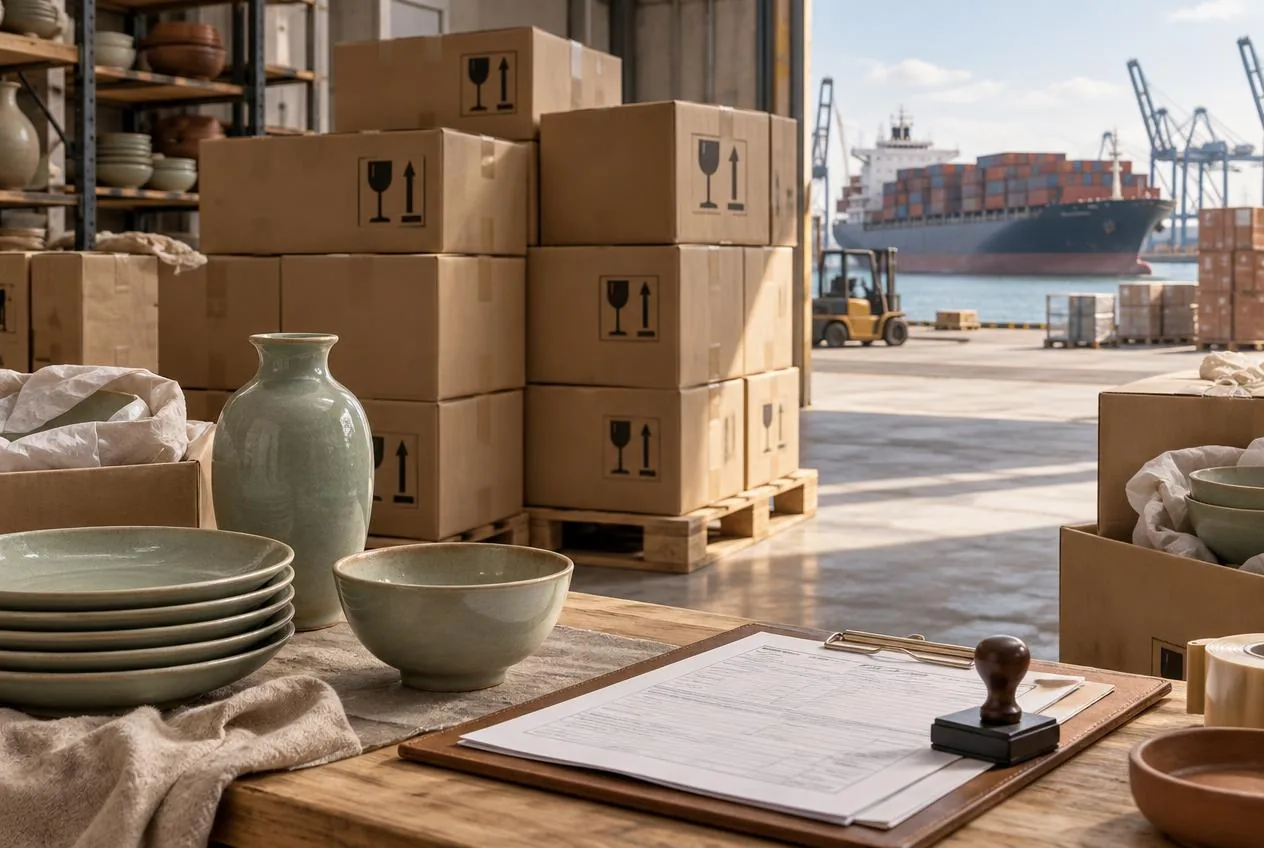
On 29 August 2025 the United States suspended the $800 de minimis exemption for all countries, and low-value parcels now clear customs with duty paid. For ceramics sellers — whose products are fragile, moderately heavy and rarely high-value — the change rewrote unit economics overnight. This guide explains the rules, compares the operating models that still work, and shows how to reprice a ceramics line for the post-de minimis world.
What changed, and when
| Date | Event | Effect |
|---|---|---|
| 30 July 2025 | Executive Order 14324 signed | Suspension of duty-free de minimis treatment announced for all countries |
| 29 August 2025 | Suspension takes effect | Parcels previously eligible for the $800 exemption now owe duties at entry |
| 2 September 2025 | Federal Register implementation notice | Operators have the published mechanics: entry types, collections, exceptions |
| 20 February 2026 | Executive Order 14388 | Suspension continued; the policy stands as of our September 2026 review |
Postal channels versus commercial channels
The two pathways now diverge sharply. International postal shipments face temporary per-item duties in tiers of $80, $160 and $200 depending on the origin country tier — which, on a $25 ceramic mug, is not a cost line but a business-model terminator. Commercial channels work differently: consolidated parcels clear through formal entries, with duty either prepaid by the shipper under DDP terms or billed to the receiver. Every serious ceramics fulfillment operation has moved to the commercial path, because it is the only one where duty scales with declared value instead of destroying it.
Why ceramics feel this change more than most categories
- Low value, real duty. A single mug or side plate carries a goods value where duty plus brokerage can rival the product cost itself. Categories with higher order values absorbed the change; low-ticket ceramics could not.
- Fragility compounds everything. Without professional packing, breakage rates for fragile goods run around 5–8% by industry estimates — and every damaged parcel burns the product cost, the packaging, the freight and the duty together.
- Heavier parcels. Ceramics ship at weights where the courier surcharges that were already painful become a larger share of a duty-inclusive total.
Four operating models after de minimis
| Model | How duty is handled | Best suited for |
|---|---|---|
| DDP consolidated air parcels | Forwarder prepays duty at formal entry; one landed rate per order | Samples, first orders, low-volume launches |
| Overseas warehouse | Bulk import with duty paid once; domestic last-mile dispatch | Proven SKUs with repeat velocity |
| Sea or air bulk plus local fulfillment | Container economics for reorders; duty embedded in stock cost | Stable catalogs with predictable sell-through |
| Direct international post | Per-item duties of $80–$200 make the math unworkable | Retired as a ceramics model |
The default stack we recommend for ceramics is the one described across our dropshipping operations guide: air-parcel DDP for samples and trial orders, then sea or warehouse consolidation once a SKU proves velocity. De minimis did not kill ceramics dropshipping — it killed the version of it that pretended duty did not exist.
Repricing a ceramics line for duty-inclusive reality
Start from COGS, not from the old retail price. Add the product cost, freight, the duty line (Section 301 List 3 adds 25% on most ceramic tableware codes, plus the current 2025-onward layers), a share of brokerage, and the breakage reserve. Only then apply your target margin. Sellers who instead kept old prices and "ate" the duty discovered the margin problem at the first stockout, not the first sale. Two adjustments soften the hit without deception: bundle items into sets so the duty and freight spread across a higher order value, and show the landed-price logic in your pricing so customers compare you on total cost rather than pre-duty illusions.
Entry compliance basics for US-bound parcels
- Classify correctly: porcelain tableware in the 6911.10 family, other ceramics in the 6912.00 family, mapped to the exact 10-digit code with your broker.
- Declare realistic values. Undervaluation to shrink the duty line converts a cost problem into a penalty problem.
- Keep food-contact documentation ready: FDA lead and cadmium action levels under 21 CFR 109.16 apply to ceramic tableware, and entry questions are easier with reports on file — the compliance overview lists the limits and methods.
- Agree the duty payer in writing — DDP with duty named, or DAP with the receiver informed before checkout, not after.
Duty policy is now a moving part of US sourcing math. Re-verify the current layers per 10-digit code before each production cycle — our tariffs hub tracks the standing EU, US and UK positions in one place.
Frequently asked questions
Is the de minimis exemption gone permanently?+
The suspension took effect on 29 August 2025 under Executive Order 14324 and was continued by Executive Order 14388 in February 2026, so as of our September 2026 review it remains in force. Treat it as standing policy for planning, and verify current status before major pricing decisions.
What duty applies to a single ceramic mug shipped to the US now?+
The parcel clears through a formal entry: the Section 301 List 3 layer of 25% plus current 2025-onward layers applies on the goods value, with brokerage on top. Under a DDP arrangement the forwarder folds these into one landed rate — ask that the duty be named in the quote.
Does the US change affect B2B shipments too?+
Commercial B2B shipments were always formally cleared, so the operational change is small — the duty stack existed anyway. The bigger 2026 duty event for B2B buyers is in Europe, where the EU applied a single 79.0% anti-dumping duty on Chinese ceramic tableware from 7 February 2026.
Should I switch to an overseas warehouse model?+
It depends on velocity. If a SKU sells steadily, bulk import with duty paid once beats per-parcel entries on both cost and delivery speed. If it sells slowly, warehouse holding costs can exceed the duty savings — start with DDP parcels, then graduate the proven SKUs. Compare the four models in the table above against your actual US sales profile before committing storage fees.
To see what a duty-inclusive US landed cost looks like for your catalog, request a quote with the tariff layers itemized.