Since 7 February 2026, one number defines ceramic tableware sourcing into the European Union: 79.0%. This guide explains what Regulation (EU) 2026/274 did to landed cost, which food-contact files an EU consignment needs under EC 84/500/EEC, how rail freight changes the replenishment math, and why duty-transparent quoting is now the dividing line between suppliers worth briefing and suppliers worth dropping.
The duty: one uniform rate where a table used to be
From 2013 until early 2026, EU anti-dumping duty on Chinese ceramic tableware ran on a split system: company-specific rates from 13.1% to 36.1%, with a residual rate for everyone else, and a company's rate depended on cooperation in earlier reviews. Regulation (EU) 2026/274, in force from 7 February 2026, replaced that structure with a single uniform anti-dumping duty of 79.0% on Chinese ceramic tableware. There is no longer a rate advantage to hunt for among named exporters — the rate is the rate, for every Chinese origin consignment.
Two practical consequences follow. First, the duty is now the dominant line in EU landed cost: on the same CIF value it dwarfs freight, insurance and clearance combined, so any sourcing decision made without modeling it is not a decision. Second, the measure faces a legal challenge, and trade-measure litigation can end in confirmation, amendment or repeal. Until an outcome is published, the correct planning stance is to model the 79.0% as standing — not to bet a buying season on a court case. We track the challenge and any successor measures on the tariff hub.
Quoting discipline: say what the price includes
The uniform duty made one contract line non-negotiable: an EU quotation must state explicitly whether the anti-dumping duty and import VAT are included or excluded. A FOB price and a DDP price on the same stoneware set can differ by more than the goods are worth, and under-invoicing or origin games to dodge the duty are not strategies — they are the transshipment trap, and customs authorities in the EU are actively checking origin claims. When we quote EU buyers, the duty line and the VAT treatment appear as separate named lines, so the comparison between two quotations starts from the same ground. If a supplier cannot produce that breakdown, the missing line is your risk, priced by someone else.
Food contact: EC 84/500/EEC and the CE file
Duty does not replace compliance. Ceramic tableware placed on the EU market must meet the migration limits of EC 84/500/EEC, tested in 4% acetic acid, and the amending Directive 2005/31/EC added the CE marking and Declaration of Conformity obligations that tie the product file together.
| Ware category | Lead limit | Cadmium limit |
|---|---|---|
| Flatware (plates, saucers) | 0.8 mg/dm² | 0.07 mg/dm² |
| Small hollowware and storage/vessels | 4.0 mg/dm² | 0.3 mg/dm² |
The file that travels with the goods should contain the migration test report on the shipped decoration, the Declaration of Conformity, and consistent product identification across invoice, packing list and report. German retail programs frequently write stricter LFGB limits into their specifications — treated across the industry as the gold standard — so it pays to know before sampling whether your buyer applies the EU baseline or the German one. Both routes run through our compliance program, and underglaze decoration again earns its place structurally: color sealed under the glaze is the lowest-migration-risk way to carry a design.
Freight: air for trials, rail for the middle path
EU-bound freight has three speeds. Air freight, typically 7-15 days door to door from China, suits samples, testing submissions and first market tests. Rail freight — the China-Europe land bridge — runs typically 18-35 days at roughly one third of air cost, which makes it the working replenishment route for many EU programs: slower than air by half a month, faster than ocean by weeks, and gentler on the duty-heavy landed cost than flying cartons of stoneware. Ocean remains the choice for full-container programs where the calendar allows. For rail and ocean consignments, palletizing discipline matters: foam corner protection, IPPC-treated timber or plywood crating, and carton stacking plans that survive 35 days of vibration, not just the first day of it.
What EU programs actually order
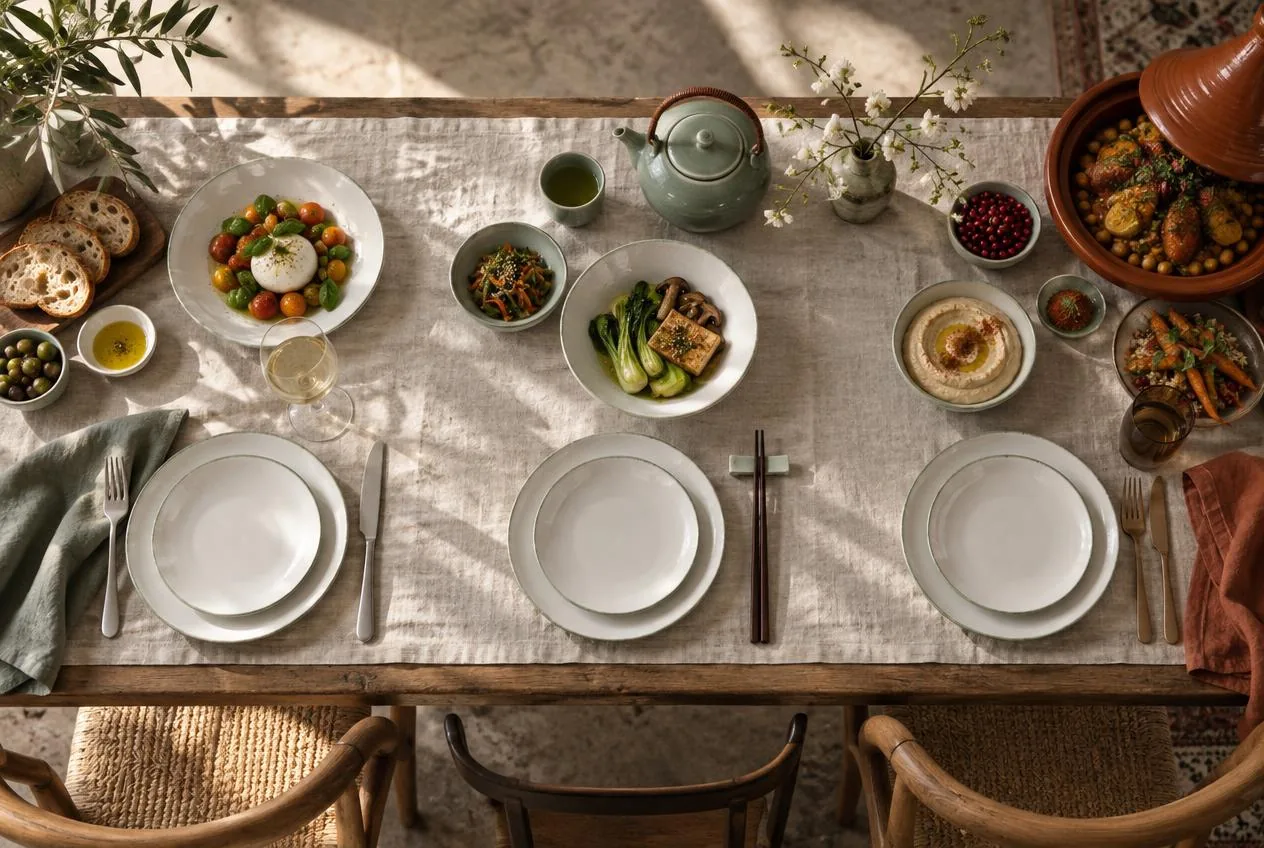
European taste in tableware rewards restraint. Matte stoneware in muted glazes, clean underglaze blue, celadon and understated white porcelain move in deeper volumes than ornate decoration, and the pieces that repeat are the ones that stack, wash and layer — 16-piece everyday sets for retail, open-stock bowls and mugs for housewares, teapots and tea sets for the specialty end. That is a preference pattern, not a rule, but it is consistent enough across the programs we serve that we plan glaze lines and shape libraries around it.
The uniform duty changes assortment economics in a specific way: at 79.0% on the customs value, decoration complexity must earn its freight and its duty. Heavy multi-color decals that looked viable at a 17.9% company rate deserve re-costing at the uniform rate — sometimes the answer is a simpler decoration on a better body, which is also the answer European buyers tend to prefer aesthetically.
Checklist before the deposit
- Model landed cost at the uniform 79.0% anti-dumping duty, and state in the PO whether duty and VAT are included in the quoted price.
- Confirm the HS classification (6911 porcelain versus 6912 other ceramics) with your broker before the first entry.
- Require a migration test report against EC 84/500/EEC limits on the shipped decoration, plus the Declaration of Conformity under 2005/31/EC.
- Ask early whether your buyer program applies the EU baseline or stricter LFGB limits.
- Choose the freight tier deliberately: air 7-15 days for trials, rail 18-35 days for replenishment, ocean for full containers.
- Approve a golden sample with packing spec, and keep product identification identical across the compliance file and shipping documents.
The measure is under legal challenge. That is a reason to keep paperwork immaculate — so you can re-price quickly if the duty moves — not a reason to book against a hoped-for repeal. Plan on 79.0% until an official change is published.
Frequently asked questions
Is the EU anti-dumping duty on ceramic tableware now 79%?+
Yes. A uniform 79.0% duty applies to Chinese ceramic tableware from 7 February 2026 under Regulation (EU) 2026/274, replacing the earlier 13.1-36.1% company-specific structure. The measure is under legal challenge, so track updates on the tariff hub.
Does the uniform rate apply in every EU member state?+
Yes. It is a common EU trade-remedy measure, so it applies at the customs border of every member state. Food-contact enforcement details and retail specification culture still vary by country — Germany is the strictest documented case.
Can I avoid the duty by shipping through another country?+
No. The duty follows origin, and routing goods through a third country without genuine transformation there is transshipment, which customs authorities actively investigate. The legitimate routes are different origins or absorbing the duty.
What documents does an EU-bound ceramic shipment need?+
The standard trade set — commercial invoice, packing list, transport document — plus the food-contact file: migration test report to EC 84/500/EEC limits and the Declaration of Conformity under 2005/31/EC.
For the regional view — duty posture, buyer preferences and freight lanes — see the Europe market page. When you want an EU quotation with the duty and VAT lines spelled out rather than buried, request a duty-transparent quote.