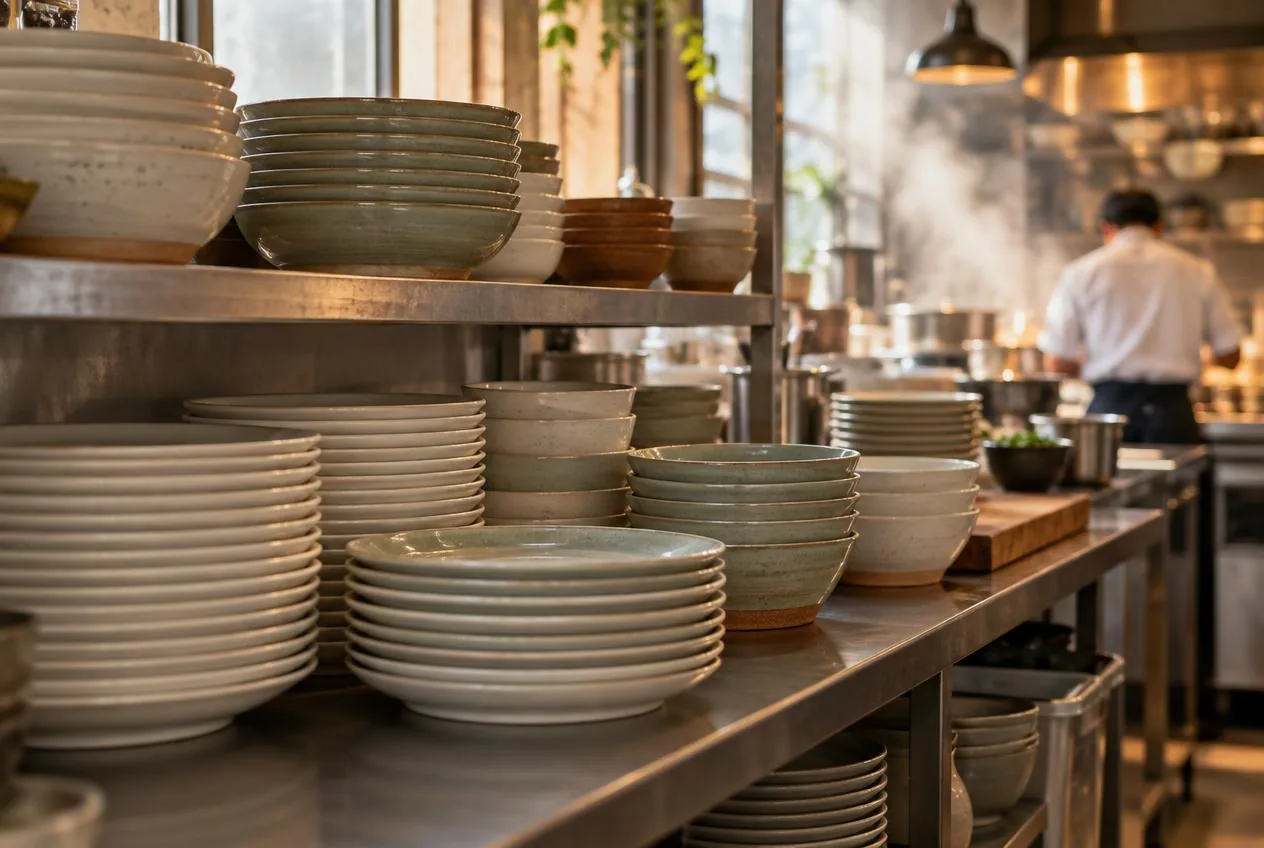
Hotel porcelain is bought on capital cycles measured in years, yet many properties specify it like a seasonal refresh — and pay for that mistake in mismatched replacements by year two. This article is for hotel procurement, engineering and F&B leads: how to zone a porcelain program across outlets, what belongs in the written specification, and the continuity clause that protects year three.
A hotel does not run one restaurant. It runs an all-day dining room, a banquet operation, in-room dining, a pool deck and a bar — all wearing the same brand, all consuming porcelain at different rates. Programs specified as a single catalog set degrade unevenly: banquet plates chip first, in-room saucers wander off, and within two years the property is mixing purchase generations that no longer stack or match. Zoning the specification is the discipline that prevents this.
Zone the program by service environment
Start by mapping every touchpoint where the property serves food or beverage on ceramic, then assign each zone its own priority. The table below is a starting frame most properties can adapt directly.
| Zone | What stresses the ware | Specification priority |
|---|---|---|
| All-day dining | High turn, dense dish-machine cycles | Reinforced body, stackable formats, deep par |
| Banquet and events | Volume peaks, transport, tall stacks | Nesting formats, one uniform platform, deepest par |
| In-room dining | Low volume, tray service, presentation | Finer formats acceptable; lids and saucer depth |
| Pool and terrace | Hard surfaces, outdoor handling | Reinforced body; textured or deeper-toned glaze hides scuffs |
| Bar and lounge | Small formats, very high frequency | Few SKUs, deepest par, stackability |
The point of the exercise is budget honesty. Banquet ware and in-room ware do not deserve the same specification, and forcing them into one catalog set either overpays the quiet zones or under-specifies the brutal ones — usually both at once.
The technical core: fired for service
Across all zones, the working core of a hotel program is porcelain fired in the 1280–1380℃ window to full vitrification. At that density the body absorbs almost no water, survives repeated thermal cycling between the pass and the dish machine, and resists the rim erosion that racks cause. For the high-wear zones — banquet, all-day dining, terrace — specify a reinforced body with an engineered rim section; for in-room and lounge service, standard fine porcelain formats are acceptable where turnover is low and presentation leads. The mistake to avoid is the reverse: putting domestic-grade ware into banquet service because it photographed well.
Compliance and the paper trail
Hotel groups are audited, which makes documentation part of the specification rather than an afterthought. Write named standards into the tender: FDA 21 CFR 109.16 for properties serving the US market, EC 84/500/EEC with its 2005/31/EC additions for the EU, LFGB where the group's German-market standard applies. Require third-party migration test reports against the applicable standard — available on request from credible manufacturers — and link them to the production batch, not just the sales sample. A property that can produce a report matching its shipped ware answers any environmental-health inspection in minutes; a property that cannot, answers it over months.
Quantities and phased delivery
Size each zone's par from its own turnover, then add the property-level buffer. Hotel-program lines typically carry MOQs around 1000 pieces per SKU, which is generous for a boutique property and modest for a large operation — the usual resolution is to standardize the platform, one white reinforced body in a few formats, and phase delivery across outlets rather than chase every zone's wish list. A pilot on open-stock models near 500 pieces per SKU can validate formats before the full program commits. Delivery scheduling matters too: a renovation property usually needs ware phased floor by floor, aligned to room-block openings rather than to the factory's convenience.
Continuity: the clause that saves year three
The most neglected line in hotel porcelain tenders is continuity. Ware breaks, pieces walk off, and renovation refreshes create top-up demand years after the original order — and if replacement pieces come from a different mold or glaze batch, they will not sit level in a stack with the survivors. Write three things into the contract: the supplier keeps the molds active for an agreed period; reorders are matched against retained golden samples for color and dimension; and glaze-batch top-ups are aligned to production runs to limit visible variance. For custom or logo programs this is tooling territory — specify mold retention explicitly with your OEM partner, because once a mold is retired, matching is no longer on offer.
Assembling the program
Done well, a hotel porcelain program is a small set of decisions recorded in writing: zones with their own priorities, one reinforced high-fired platform for the heavy zones, named compliance standards with reports on file, par sized per zone with a property buffer, and continuity clauses that survive staff turnover. Properties reviewing the shape of a full program can see it laid out on our hospitality program page, browse coordinated dinnerware sets for zone formats, and bring a zoned specification directly to a quotation request for per-zone pricing.
Frequently asked questions
Should all hotel outlets use the same porcelain line?+
Standardize the platform, not the grade. One reinforced high-fired white body in common formats keeps stacks, washes and reorders aligned; low-wear zones like in-room dining can take finer formats where presentation earns it. What breaks programs is mixing grades inside a single high-wear zone.
What MOQ should a mid-size hotel expect?+
Open-stock commercial models commonly start around 500 pieces per SKU, and hotel-program lines typically at 1000. Smaller properties manage the floor by standardizing on fewer formats ordered deeper, or by piloting on open stock before committing to the program line.
How do we match replacements years later?+
Through three contract lines agreed at purchase: mold retention for an agreed period, golden-sample matching for color and dimension, and batch-aligned top-ups. Without them, expect visible drift — and phase replacements by format rather than mixing generations in one stack.
Is bone china suitable for hotels?+
In controlled-service settings, yes — bone china fires around 1380℃ and delivers translucency and refinement that signature restaurants trade on. For banquet floors, pool decks and high-turn dining rooms, reinforced porcelain remains the duty-rated choice; reserve bone china for the zones where handling is gentle by design.