Cafés do not lose dinner plates — they lose mugs, by the handle, twice a season if the program is wrong. This article is for café owners and small-chain procurement: what churn actually costs, how to specify a mug that survives a year of racks and counters, and how to keep brand identity without buying fragility along with the logo.
Cafés churn mugs, not plates
The usage profile of a café is unlike a restaurant's. Plates turn over moderately; mugs are gripped, parked on counters, caught on sinks, and loaded into racks with the handle as the leverage point. The handle is the failure point of café ceramics: a knock that leaves a plate with a bright mark takes a mug's handle clean off. Add saucers that wander off and never return, and the café's real ceramic budget is a mug-and-saucer churn budget. Programs that recognize this buy differently from the first order — everything else in the café is comparatively stable.
The cost of churn, made visible
Churn is usually priced wrongly because only the mug's unit price is counted. Illustrative scenario: a café that replaces its mug stock twice a year pays the unit price twice — plus freight twice, customs paperwork twice, receiving and inspection twice, and a season of mismatched mugs on the shelf in between. A more durable mug at a higher unit price that turns once in two years is not a marginal saving; it removes an entire administrative cycle from the calendar. The arithmetic is the same cost-per-cover logic restaurants use, applied to the cup counter: durability is bought once, churn is paid for at every cycle.
Specifying a café mug
Four features decide a mug's service life. Handle geometry: clearance for rack compartments and a junction thick enough to take knocks — the single highest-leverage spec line in the format. Wall and base section: enough body under the handle junction and base to resist impact, without tipping into clumsiness. Footring: finished and smooth, because mugs stack and grind at the foot long before anyone notices. Glaze and decoration: a hard lead-free glaze, with the logo applied underglaze where identity matters, because on-glaze prints fade in racks within a season.
State capacity in milliliters in the specification — the convention that keeps quotes comparable — and confirm food-contact compliance by named standard: for cups and mugs, FDA 21 CFR 109.16 sets the lead limit at 0.5 µg/mL for the US market, while EC 84/500/EEC governs the EU categories. Third-party test reports are available on request from credible manufacturers.
Plates and bowls for café service
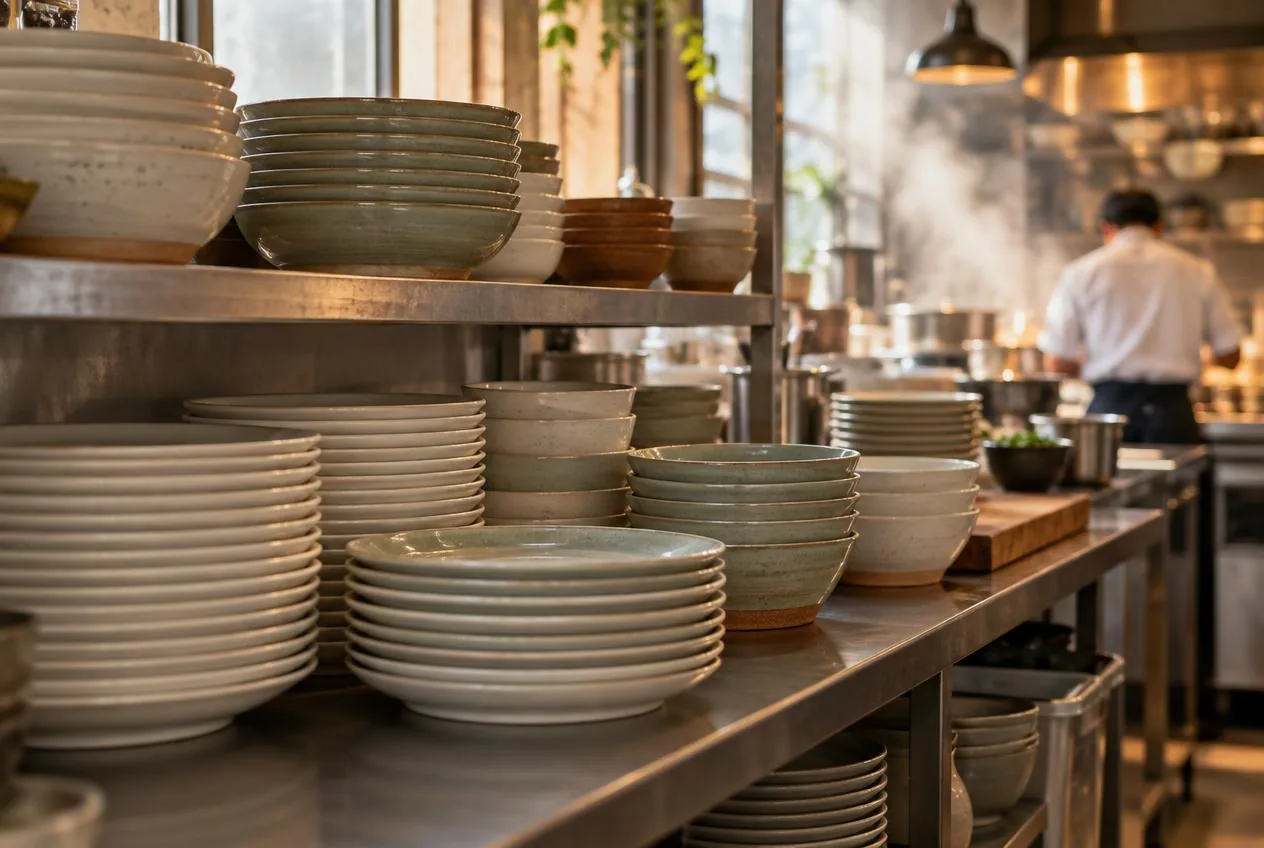
Café food service leans on a compact format set: a breakfast or pastry plate, a larger brunch plate for all-day menus, and a bowl for the granola-and-salad half of the menu. The specification carries over unchanged from restaurant programs — fully vitrified high-fired body in the 1280–1380℃ window, reinforced rims, finished footrings, stackable formats — because a café's dish machine and racks are commercial equipment even when the room is small. The only café-specific adjustment is par: fewer SKUs, deeper counts, since a café's menu breadth is narrower than a restaurant's and its storage usually is too.
Identity without fragility
Most cafés want the logo on the mug; the mistake is buying the logo in a form that cannot survive the rack. Underglaze decals and in-glaze application put the mark beneath a hard glaze surface. On-glaze golds and brights photograph beautifully and sit at the top of the wear list — reserve them for merchandised pieces, not daily drivers. Custom decoration raises the order floor: custom lines typically start around 1000–3000 pieces per SKU, against roughly 500 for open stock, so the usual path is standard durable bodies with custom decoration rather than fully bespoke shapes. Our custom program covers that route, and the hospitality program page shows how the same mug specification scales across multi-site chains.
Assembling the program
A café program that holds its look for years is short: a durable mug spec with rack-clear handle geometry; one breakfast and one brunch plate; one nesting bowl; deep par on few SKUs; and decoration chosen for wash life rather than for the product photo. Browse the mugs and cups range for formats specified this way, and price a season-proof set through a quotation request with your peak-day cover count included — that one number sizes the par correctly the first time and saves a full reorder cycle later.
Frequently asked questions
Why do mug handles break off?+
The handle is a lever arm, and its junction with the body concentrates every knock. Thin or decorative handles fail first in racks and sinks. Specify rack-clear handle geometry with a thickened junction — it is the highest-leverage line in a café mug specification.
What MOQ applies to logo mugs?+
Custom decoration typically starts around 1000–3000 pieces per SKU, while standard bodies run near 500. The middle path most cafés take: a standard stock body with custom underglaze decoration, ordered deep enough to reach the volume step.
Are printed logos dishwasher safe?+
It depends where the print sits. Underglaze and in-glaze decoration fire beneath a hard glaze surface and wash for years; on-glaze prints fade fastest in commercial racks. If the mug is washed daily, the decoration method matters more than the logo design.
How many mugs should a café hold?+
Size from peak covers plus rack turnaround plus a churn buffer, and go deep on one or two mug SKUs rather than spreading across many. Fewer formats mean matching saucers, deeper volume steps and a shelf that always reads uniform.