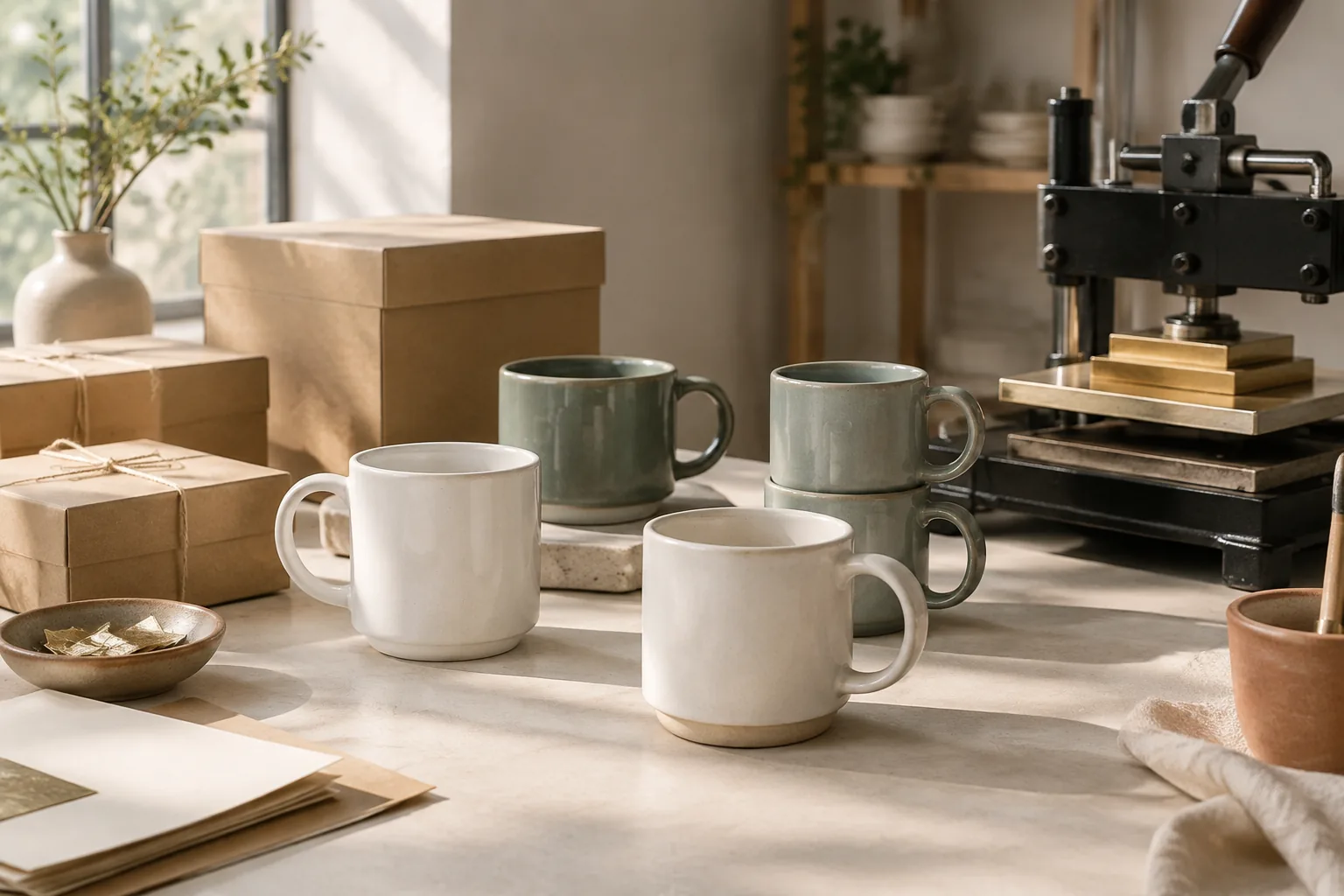
Every brand eventually wants its own color — the sage green that matches the packaging, the terracotta from the mood board. Getting it onto dinnerware is a kiln chemistry problem, not a printing problem, and the gap between a Pantone reference and the fired piece is where unprepared programs burn months. This article explains how glaze color development actually works and how to run it so the color you approve is the color you keep receiving.
Glaze is not ink. It is a glass layer whose final color emerges from mineral chemistry, firing temperature and cooling behavior — which means a color chip printed on paper is a direction, not a specification. Buyers who treat it like print design get a first trial that is "close" and a tenth trial that still is not; buyers who run the process below get a defensible color with a written tolerance band.
Why your Pantone chip is only a starting point
Three physical realities separate a paper reference from a fired glaze:
- Body matters. The same glaze over white porcelain and over stoneware reads differently, because the body's own tone shows through semi-opaque glazes. Color development is always body-specific — decide the body first, then develop against it.
- Temperature matters. High-fired tableware porcelain fires in the 1280–1380°C window, and bone china around 1380°C. At those temperatures some color systems burn out or shift, so the palette of stable colors at production temperature is narrower than a print catalog suggests.
- Finish changes perception. A matte surface scatters light and reads softer and lighter than the same chemistry fired glossy. Approving the color and the finish separately never works; they are one decision.
None of this makes custom color impractical. It makes it a development loop with defined exits, which is precisely how our custom program runs it.
The development loop, step by step
- Freeze the inputs. Body, firing route, finish (gloss, matte, reactive) and the color reference — physical chip if you have it, lab values if you do not. Changes to any input restart the loop; say so in writing.
- Lab trials. The factory's glaze lab blends candidate recipes and fires small tiles in the target body. Expect several candidates, each slightly off in a different direction.
- Production-condition trials. The best candidate is fired as a real piece — a plate, a mug — in the production kiln, not a test kiln. Kiln position and load affect color at the margins, and only real pieces reveal that.
- Set the variation band. No kiln produces a single identical color across thousands of pieces. Approve a band: several fired samples spanning the acceptable range, from light end to dark end.
- Golden sample lock. The band and the target piece are sealed — one set retained by the factory, one by you — and referenced by date in the purchase order.
- Production check against the band. First-article inspection compares fired production pieces to the band under agreed lighting, not to a memory of the meeting.
Approve a color and you have a mood board; approve a band of fired samples and you have a specification. The difference is what disputes get settled with.
What moves a color between batches
| Drift source | What you see | Control that works |
|---|---|---|
| Glaze batch mixing | Whole batch slightly lighter or darker | Recipe recorded against the golden sample; new batches verified against the band before release |
| Kiln load and position | Pieces from one firing vary subtly | Band tolerance wide enough to absorb normal kiln spread — set it during development |
| Body tone variation | Same glaze reads different over a new body lot | Body specified alongside color; body changes trigger re-verification |
| Finish drift | Matte turning satin after a recipe shortcut | Finish named in the PO with the golden sample as the arbiter |
| Lighting in approval | "Approved" color looks wrong in daylight | Agree viewing conditions — daylight-balanced light plus the retail environment it must match |
Reactive glazes: variation is the product
Reactive glazes — the mottled, flowing stoneware finishes popular in lifestyle retail — behave by a different logic. Their chemistry is deliberately unstable, so piece-to-piece and even spot-to-spot variation is the intended look. Here the development loop matters even more: the band you approve effectively becomes the product definition, because there is no such thing as one exact reactive color. Brands that skip band-setting on reactive lines spend their customer-service life explaining pieces that are all technically correct. Set the band generously at the edges but firmly at the center, and put both ends in the purchase order.
Color and the food-contact rules
Color development touches compliance in two places. First, colored glazes and decoration systems in the food-contact zone must meet the market's migration limits — FDA 21 CFR 109.16 in the US (lead limits of 3.0 / 2.0 / 0.5 µg/mL for flatware, holloware and cups-mugs, with cadmium enforcement under CPG 545.400, tested by ASTM C738) and EC 84/500/EEC in the EU (0.8 / 0.07 mg/dm² lead and cadmium for flatware, 4.0 / 0.3 mg/dm² for containers). Second, some vivid historical pigments are exactly the chemistries those limits exist to control — which is why lead-free glaze systems and underglaze color are the structurally safer choices for eating surfaces, and why we recommend them for any eating or drinking zone. Third-party migration test reports on the finished glaze are available upon request; the compliance page lists what to ask for by standard number.
A developed colorway is the fastest way to make a stock form feel proprietary — it is the tier-two move in most brand roadmaps, and it applies cleanly across the dinnerware sets and teaware ranges once the band is locked. To start a color development, send the reference and the target body, and we will scope the trial loop honestly, including how many rounds a demanding shade typically takes.
Frequently asked questions
How close to my Pantone reference will the fired glaze get?+
Close enough to read as the same color in a retail setting is the honest target, especially for matte and reactive finishes where the surface itself shifts perception. Development converges faster when you supply a physical reference and accept the finish's natural influence on how the shade reads.
Why do I need to approve a band instead of one sample?+
Kilns vary within normal production spread, and a single approved sample gives inspectors no tolerance on either side. A band of several fired samples defines the acceptable range, so both your QC and the factory's are measuring against the same written boundary instead of arguing taste.
Can the same custom color run on porcelain and stoneware?+
The recipe must be developed per body, because the body's tone shows through semi-opaque glazes and the firing routes differ. Expect a separate short trial loop when porting a proven color to a different body rather than a straight transfer.
Who owns the developed glaze recipe?+
Whatever the contract says. Put it in the pro forma invoice: exclusivity on the recipe for defined markets and a term, and the consequences if the same colorway appears in the factory's open range. Recipe ownership is enforced by paperwork, not by chemistry.