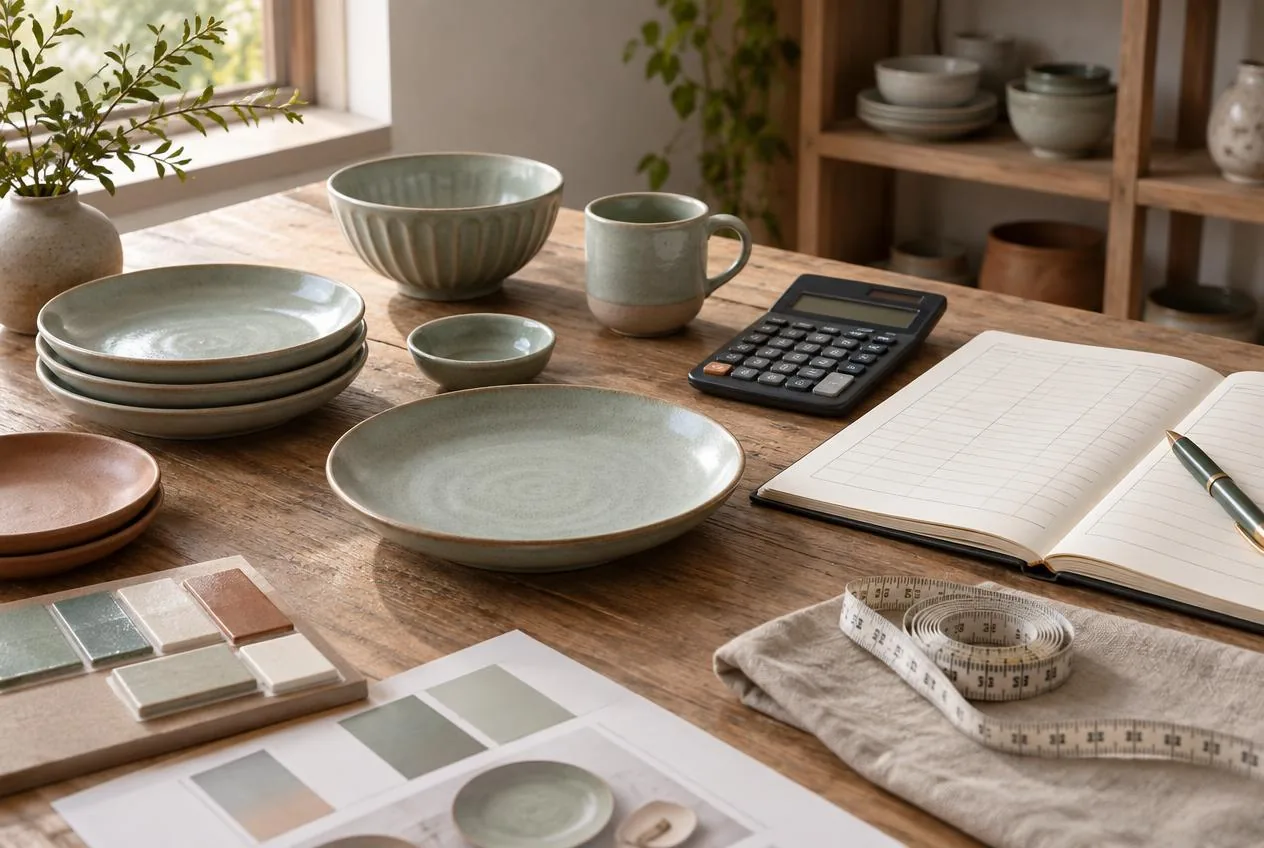
Sampling is the least expensive stage of a ceramic buying program and the most expensive stage to get wrong. A few hundred dollars spent here decides whether a 500-piece order lands as the product you pictured or as a listing you have to relist. This article prices the sampling stage honestly — existing items, custom development, couriers and lab tests — and turns it into a budget you can defend.
What you are actually paying for
A sample fee is not a fee for a piece of ceramic. On a stock item, it covers pulling the piece from current production, packing it and handing it to a courier — modest work, modest cost. On a custom item, the fee sits on top of real development: mold time on a shared or new plaster mold, an artist's hours for hand painting, glaze trials to hit your reference color, and the packing engineer's time if your sample must also prove an e-commerce carton. That asymmetry explains why two sample quotes for seemingly similar requests can differ by a multiple, and why the custom fee is not a negotiation insult — it is the visible edge of a 1,000–3,000-piece development program.
There is a third cost hiding inside both: time. Every sampling round consumes weeks, and weeks matter more than fees in a seasonal category where the autumn tableware window closes regardless of where your approval stands.
The sampling budget, line by line
The table below is a realistic first-program budget for a buyer testing one stock dinnerware set and one custom mug shape, in two rounds. All figures are illustrative — actual fees depend on the supplier, the decoration and the courier lane — but the line structure is what matters, because the lines buyers forget are always the same ones.
| Line | What it covers | Illustrative cost |
|---|---|---|
| Round 1: stock samples | Existing-set sample, packed | $85 |
| Round 1: custom sample | New shape, first glaze and decoration trial | $220 |
| Courier, round 1 | Air parcel from China | $60 |
| Round 2: revised custom sample | Color and weight corrections after review | $180 |
| Courier, round 2 | Air parcel | $60 |
| Golden sample retention | Sealed reference set held at the factory | $95 |
| Pre-production sample | Pulled from the first production run, not the sample room | $95 |
| Lab testing | Lead and cadmium release on the decorated article | $350 |
| Sampling total | $1,145 |
Against the goods value of a 500-piece order, this stage is a rounding error. Against the cost of approving the wrong glaze, it is the least expensive mistake prevention on the entire program. Buyers who trim the pre-production sample or the lab line to save a few hundred dollars are optimizing the least consequential column of the budget.
Existing items versus custom development
The sampling economics should inform the product decision itself. A stock body with your decoration reaches a decision quickly and at modest cost, because the body has already survived production — weight, rim profile, glaze behavior and packing are known quantities. A fully custom shape is a development project: the first sample is a hypothesis, and a second round is the norm rather than a failure. Plan two rounds for custom and one round for stock, and you will almost never be surprised. The one place to be strict is hand-painted work: brushwork varies by artist and by day, so the sample must be judged as a style reference with agreed tolerances, not as a piece to be matched stroke for stroke.
The samples that save programs
Three samples carry disproportionate weight. The golden sample is the physical contract — the piece that both sides accept as the definition of the item, sealed, dated and referenced by number in the proforma invoice. The pre-production sample comes off the actual production line with the actual glaze batch, catching the drift between sample-room craft and factory routine while there is still time to react; on any order above trial size it is not optional. And a set of glazed reference chips — small tiles of each glaze and decal — costs little, ships flat and settles color disputes for the life of the program. A supplier who resists sealing a golden sample is telling you something about the next twelve months of the relationship.
Testing samples: the non-negotiable line
Food-contact testing is the one sampling line with regulatory consequences attached. For the United States, the FDA framework in 21 CFR 109.16 sets lead release limits under 4% acetic acid — 3.0 for flatware, 2.0 for holloware and 0.5 for cups and mugs, in micrograms per milliliter — with cadmium enforced through CPG 545.400 at 0.5 for flatware and 0.25 for cups and mugs, tested by ASTM C738. For the European Union, Directive 84/500/EEC sets migration limits per square decimeter, and 2005/31/EC adds declaration-of-conformity obligations. Germany's LFGB regime is stricter still and is treated in the trade as the reference standard. Two rules keep this line honest: test the decorated article, not the bare body — decoration is where release risk lives — and treat every result as a document to file, with compliance documentation organized per SKU from the start. Reputable suppliers work with third-party laboratories, and test reports are available upon request; a supplier who cannot produce one for a decorated article has answered a different question entirely.
Before you pay the sample invoice
- Confirm what the fee covers: piece only, or piece plus packing spec and decoration file? A sample that ships without its intended export packing tests only half the product.
- Ask whether the fee is credited against the production order — common on custom programs once an order follows, and worth asking for on every one.
- Put the reference standard in writing: glaze code, decal number, weight and dimensions, so round 2 has a defined target.
- Budget the courier both ways if you return corrected samples or reference pieces; parcels are a real line at express rates.
- Schedule the lab test to start from the sample you intend to approve, not from an early trial — testing a piece you are about to revise spends the money twice.
When the sampling stage is done and the golden sample sealed, the quotation that follows should reference it by number. If you are assembling that request now, the quotation page lists what to include so the production quote inherits the sampling decisions instead of reopening them.
Frequently asked questions
Are sample fees refundable if I place the order?
Often yes on custom programs, and it is a fair thing to ask for explicitly — usually structured as a credit against the first production order once it is placed. On stock items the fees are small enough that suppliers may waive them against an order, but treat that as a courtesy to request, not an entitlement.
How many sampling rounds should I plan for?
One round for stock bodies with standard decoration, two for custom shapes or matched colors, and a third only if the first custom round revealed a structural problem rather than a tuning one. Every additional round costs fees and weeks, and weeks are usually the larger loss in a seasonal category.
Can I skip lab testing if the supplier says the item is compliant?
No. Verbal compliance is not a document, and the decorated surface is where lead and cadmium release risk actually lives. Third-party test reports on the decorated article are available from serious suppliers upon request, and the cost of one test is trivial against the value of a blocked shipment or a recall.
What is the difference between a golden sample and a pre-production sample?
The golden sample is the agreed definition of the item, sealed before production and referenced in the contract. The pre-production sample comes off the first production run to prove the factory can reproduce that definition at scale, with the production glaze batch and line conditions. One defines the target; the other verifies the process against it.