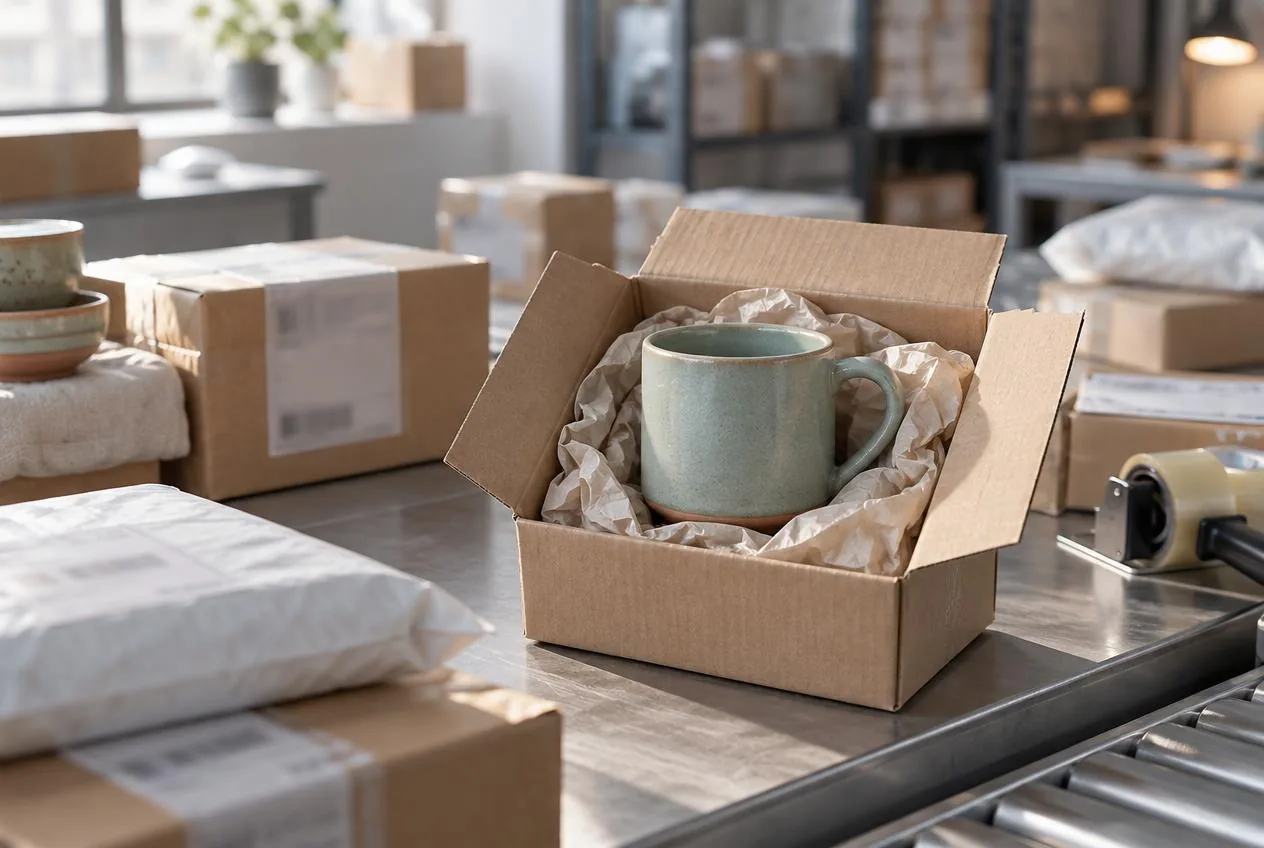
The ceramic mug is the most common first SKU in tableware dropshipping, and for good reason: it is the smallest parcel, the simplest shape and the cheapest way to validate a supplier. It is also the category where freight and duty eat the highest share of the retail price, so the unit economics deserve more scrutiny than the product's simplicity suggests. This article works the numbers from the 500-piece MOQ upward and shows where mug programs actually make money.
Why mugs are the sensible entry point
Mugs let you test three things at once with the least capital: a supplier's glaze and printing quality, their packing standard, and your own ability to sell ceramics at all. Stock programs exist in the usual shapes and capacities, at a typical MOQ of 500 pieces per SKU, and a golden sample cycle is fast because the tooling already exists. Failure is cheap; the lessons transfer directly to dinnerware sets later.
The trade-off is structural: a mug is a low-ticket item in a category where every parcel carries weight, protective packaging and — since the US suspended de minimis on 29 August 2025 — a real duty line. On a single-mug order, the logistics stack can dwarf the goods cost. The sellers who do well treat mugs not as a standalone business but as the entry ramp to bundles and sets.
Where the 500-piece floor comes from
The MOQ is not an arbitrary gate. Kilns fire in batches, and a production run below a certain volume leaves kiln capacity underused — a cost the factory has to recover somewhere. Decoration adds its own setup: a decal plate or screen is prepared per design, and that fixed cost has to amortize across the run. Glaze adds a third constraint, because color batches must match within a run, and small runs multiply the number of batches and therefore the variation risk.
That is why 500 pieces per SKU is the typical floor for stock items, and why custom decoration or private label typically starts at 1000–3000 pieces per SKU. Below those volumes, either the per-unit price stops making sense or the variation risk lands on you. Understanding this makes MOQ a negotiable structure — longer runs, fewer colors, shared shapes — rather than a wall.
Production economics at three volume tiers
The table below is an illustrative costing of one glazed porcelain mug with a single-color logo decal, at three order volumes. It is not a quotation; it exists to show which lines scale and which do not.
| Cost line (per mug) | 500 pcs | 2,000 pcs | 5,000 pcs |
|---|---|---|---|
| Ex-works mug, glazed white porcelain | $1.10 | $0.95 | $0.82 |
| Decoration setup amortized | $0.15 | $0.04 | $0.02 |
| Consolidated freight share (reorder lane) | $0.28 | $0.22 | $0.20 |
| Duty (Section 301 List 3 at 25% plus current layers) | $0.38 | $0.30 | $0.26 |
| Landed cost per mug | ≈ $1.90 | ≈ $1.50 | ≈ $1.30 |
Two lines move a lot, two barely move. The setup amortization collapses immediately — that is the reward for clearing MOQ. The ex-works price steps down more slowly, because clay, glaze and firing energy are largely fixed per piece. And freight per mug barely improves, because freight prices by weight, and a mug weighs what it weighs. The lesson: volume buys you cheap setup, not cheap physics.
The parcel side: where mug economics are won or lost
Production cost is half the model; fulfillment is the other half. The second illustrative stack shows the same mug, bought at the 2,000-piece tier, shipped as a single US-bound parcel by air DDP (5–10 days typical): goods $1.50, protective packaging $0.60, air freight share $6.50, duty and brokerage $1.20 — roughly $9.80 delivered. Sold as a four-mug bundle, the stack becomes goods $6.00, packaging $1.80, freight $8.50, duty $1.80 — about $18.00, or $4.50 per mug. The bundle did not make the mugs cheaper; it made the air and the paperwork cheaper by spreading them across more pieces.
On single-mug orders, you are running a freight business with a mug attached. On bundles and sets, the mug is the business again.
This is also why lane choice matters. Air DDP suits the validation phase, when speed of learning matters more than unit cost. Once a mug design proves velocity, consolidated sea freight — about 15–25 days to the US on express sea services — resets the fulfillment stack, and an overseas warehouse removes the per-parcel duty friction entirely. The dropshipping operations guide covers when to switch.
Differentiation that survives commodity pricing
Plain white mugs are a price war you should not enter. The differentiation that holds up in ceramics is mostly technical, not cosmetic. Reactive glazes give every piece a slightly different surface, which reads as artisanal and photographically well, and stoneware bodies with reactive glaze are a proven e-commerce look. Underglaze decoration — color fired under the glaze layer — is structurally lower-risk for lead and cadmium migration than overglaze color, which matters when customers ask about food safety and when you need to back claims with testing against FDA 21 CFR 109.16. Hand-painted lines sit at the top of the range and justify it, though they demand tighter variation communication, since no two pieces match exactly.
Whatever the direction, specify it in units customers can verify: capacity in milliliters, diameter in millimeters, and dishwasher and microwave suitability stated per glaze type. Vague descriptions generate returns; precise ones generate trust. Our dinnerware and mug programs follow that specification convention throughout.
From mugs to a mug program
The mature path is predictable. Validate with one or two stock mugs at 500 pieces. Add a second shape once the first proves weekly velocity, so the supplier relationship deepens and freight consolidates. Graduate the proven design to your own decoration at 1000–3000 pieces, then to branded packaging. Mugs are the only tableware category where that ladder can be climbed almost entirely from cash flow rather than outside capital — which is the honest argument for starting there. When you reach the private-label stage, the customization capabilities page outlines what changes, or you can request a quote with your mug concept and target market.
Frequently asked questions
Is 500 pieces a realistic MOQ for custom mugs?+
For a stock shape with a logo decal, 500 pieces per SKU is the typical floor, and the decoration setup amortizes visibly within it. Fully custom shapes, custom glaze colors or multi-color decoration usually push the MOQ to 1000–3000 pieces per SKU, because tooling and color batches dominate the cost structure.
Can single-mug dropship orders be profitable?+
Only with a retail price that carries the parcel. An illustrative single-mug order runs close to $10 landed by air DDP before any marketing, so the mug needs to sell at a price point where the freight-to-goods ratio still leaves margin. Most viable mug programs sell bundles of two to four, where the fixed part of the parcel spreads across more units.
What mug weight and size should I specify?+
Specify capacity in milliliters and diameter in millimeters — the convention serious buyers use — and state dishwasher and microwave suitability per glaze type, since reactive and hand-painted surfaces can differ from plain glazes. Weight matters mainly for freight; a packed mug typically lands in the lightest courier weight step but is often priced on volumetric weight, which is why bundling helps.
Which decoration is safest for food-contact claims?+
Underglaze decoration, where the color is fired under the glaze layer, is structurally lower-risk for lead and cadmium migration than overglaze color. Whatever you choose, back the claim with third-party lab reports against FDA 21 CFR 109.16 for the US or EC 84/500/EEC for Europe — reports are available upon request for tested lines.