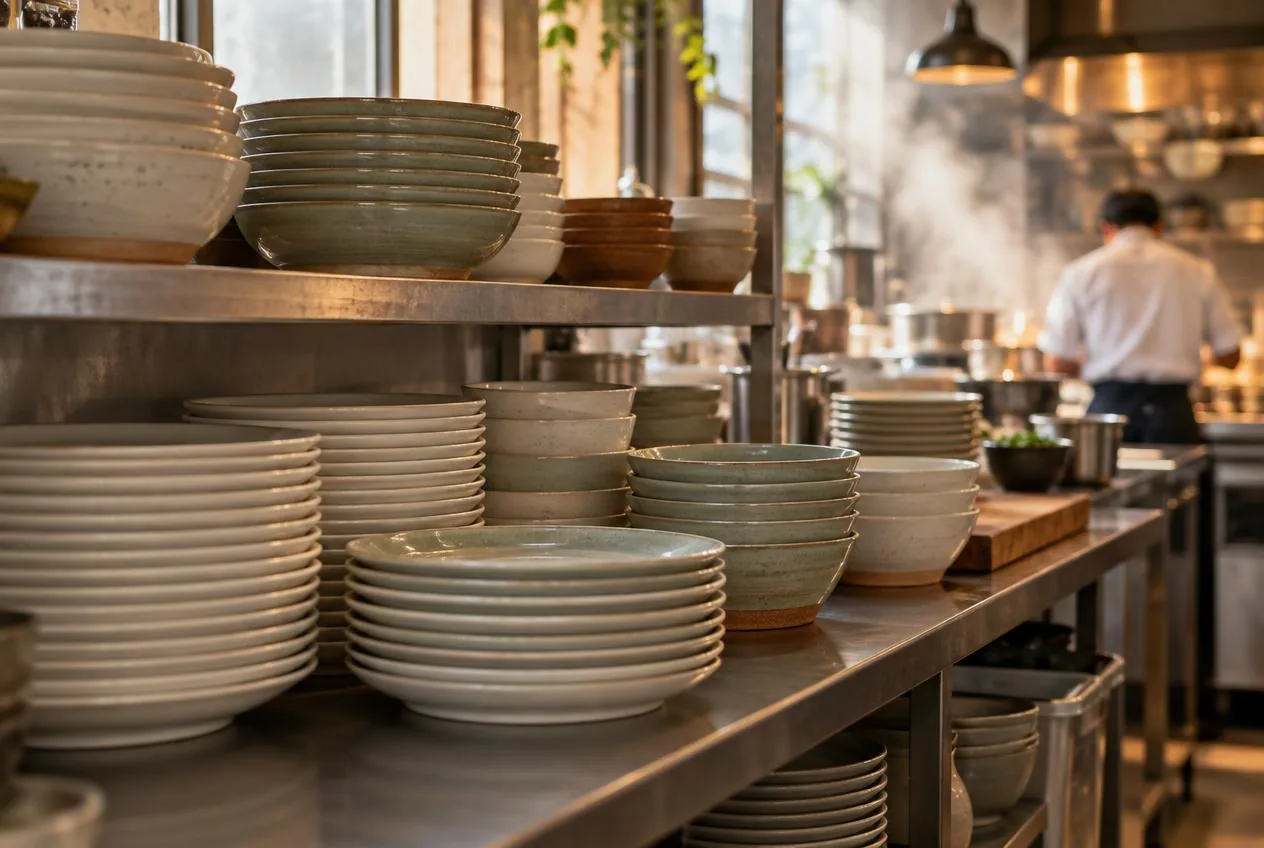
Restaurants that buy dinnerware on looks alone usually buy twice. This guide is for owners, chefs and F&B procurement teams specifying commercial dinnerware — a first build or a replacement for a program that aged badly — and it moves through the decision in the order the money does: service intensity, body, decoration, quantities, and cost per cover.
A restaurant plate is a working tool. It gets stacked, dropped into racks, scrubbed in alkaline detergent and carried through the pass dozens of times per shift. The styled retail shelf it may have been designed for tests none of that. The familiar result is a dining room that looks sharp at opening and tired by the second year, with chipped rims quietly reassigned to staff meals. Buying well the first time is mostly about not letting the catalog photo make the decision.
Start with service intensity, not style
Before opening any catalog, write down how hard the ware will work. Three questions carry most of the weight. How many covers does the busiest service run? How many times does a single piece pass through the dish machine on that day? And who handles it — a trained brigade, high-turnover floor staff, or banquet staff carrying stacks of ten? A small bistro with one evening turn and a large banquet kitchen that wants the same look still need different bodies. Intensity decides the body and rim specification; style only decides which reinforced line you choose from.
If the intensity questions have no answers yet, postpone the order. Suppliers can adjust formats and decoration quickly; no adjustment makes a light domestic body survive a banquet kitchen.
The body: what actually carries the program
Commercial programs should start from fully vitrified porcelain fired in the high-temperature window of 1280–1380℃, where fine whiteware bodies densify into a hard, low-porosity structure. That density is what resists water uptake, thermal cycling and the slow edge erosion a dish rack inflicts. Inside that window, ask specifically for a reinforced hotel body — a formulation and rim section engineered to take knocks rather than flake. Reinforced hotel porcelain runs heavier and visually plainer than domestic fine porcelain; that is the price of a body built for years of dish machines, and over a program's life it repays itself many times over.
When a supplier describes a line as "for hotels," ask what makes it so. The honest answer involves the firing window, vitrification and rim engineering — not adjectives. A supplier who can walk you through the body specification is a supplier who has manufactured for food service before; one who can only point at the photo is guessing.
Decoration and compliance: specify for the dishwasher and the inspector
Decoration is where programs most often look wrong within a year. On-glaze decals and metallic banding wear fastest under abrasive commercial dishwashing. Underglaze decoration, applied beneath the glaze and fired in, wears at essentially the rate of the glaze itself — and it carries a structural compliance advantage, because underglaze designs have inherently lower lead and cadmium migration risk. For a program that must look uniform for years, underglaze or in-glaze decoration over a lead-free glaze is the durable route.
Whatever the decoration, tie the specification to named limits rather than trust marks: FDA 21 CFR 109.16 for US operations, EC 84/500/EEC for the EU, LFGB where German-market expectations apply. Third-party test reports against the relevant standard are available on request from serious suppliers — and a supplier who hesitates at that request has answered a bigger question about the whole program. Our compliance overview lists the documents to collect before a deposit.
Quantities, MOQ and the par set
Size the order as a par set, not a seating count. A par set is enough pieces to run full service, keep the dish machine loaded, and hold clean backup on the shelf — in practice, a multiple of the seating count for the busiest formats, less for slow-turning ones. Then face the order-floor reality: open-stock commercial models commonly start around 500 pieces per SKU, while hotel-program lines and custom formats typically start at 1000 pieces per SKU or above. That economics is why operators standardize on fewer SKUs with deeper par instead of many formats with thin coverage. A compact program — a dinner plate, a smaller plate, a bowl and a mug, ordered deep — beats a ten-SKU program ordered thin on almost every measure: price breaks, storage, mismatch risk and replacement simplicity.
Cost per cover, not cost per plate
The unit price on the quotation is the least informative number on the page. Illustrative scenario only: two plates land at the same delivered price; one survives twice as long in service before chipping out. Its cost per month of service is half — before counting the labor of receiving, inspecting and phasing replacement orders, and before counting the goodwill cost of serving a guest from a chipped plate. Buyers who think in cost per cover converge on the same specification: reinforced high-fired bodies, underglaze decoration, fewer SKUs ordered deep, and a planned buffer. That pattern is not fashion; it is what service life does to arithmetic.
A buying checklist you can run this week
- Write down service intensity. Peak covers, dish-machine turns per piece, and who handles the ware.
- Specify the body in writing. Fully vitrified porcelain, high-fired 1280–1380℃, reinforced rim section; "hotel ware" only counts if the supplier can explain why.
- Choose decoration for wear. Underglaze or in-glaze over a lead-free glaze; on-glaze only where churn is acceptable.
- Attach named standards. FDA 21 CFR 109.16, EC 84/500/EEC or LFGB as the market requires; request third-party test reports.
- Size a par set with a buffer. Deep on few SKUs; plan the replacement buffer at ordering, not after the first chipped season.
- Fix the golden sample. Retain sealed reference samples of body, color and decoration for every reorder.
- Count on arrival. Inspect inbound shipments against the packing list; export-grade packing keeps transit damage low, but the count still belongs to you.
Operators who want a single starting point can review how these decisions assemble into complete dinnerware programs, or look at the hospitality program page where the same logic is laid out by venue type. When the specification is ready, bring it to a request for quotation rather than asking suppliers to propose one — the quotes you get back will be comparable, and the program will be yours.
Frequently asked questions
How many pieces should a restaurant order per format?+
Enough for a par set: full service plus the dish machine plus clean backup, which in practice means a multiple of the seating count for high-turn formats. Work backward from peak covers and dish-machine turnaround rather than from a fixed rule of thumb.
Is stoneware acceptable for restaurants?+
For low- and mid-turnover venues, yes — stoneware's thickness gives it real toughness. For high-volume service, fully vitrified reinforced porcelain is the purpose-built choice: it stacks better, resists rim flaking longer and runs more uniform in color across reorders.
What documents should a dinnerware supplier provide?+
At minimum: a written specification covering body, firing, glaze and decoration; third-party migration test reports against the standard your market requires, available on request; and a golden-sample policy for reorders. Treat certification claims without documents as claims, not facts.
Can we mix a new order with our existing plates?+
Color-wise, whites align easily. Physically, check stack heights and diameters so mixed stacks do not create rim contact in racks. Most operators phase replacements by format — plates first, then bowls — rather than mixing within a stack.