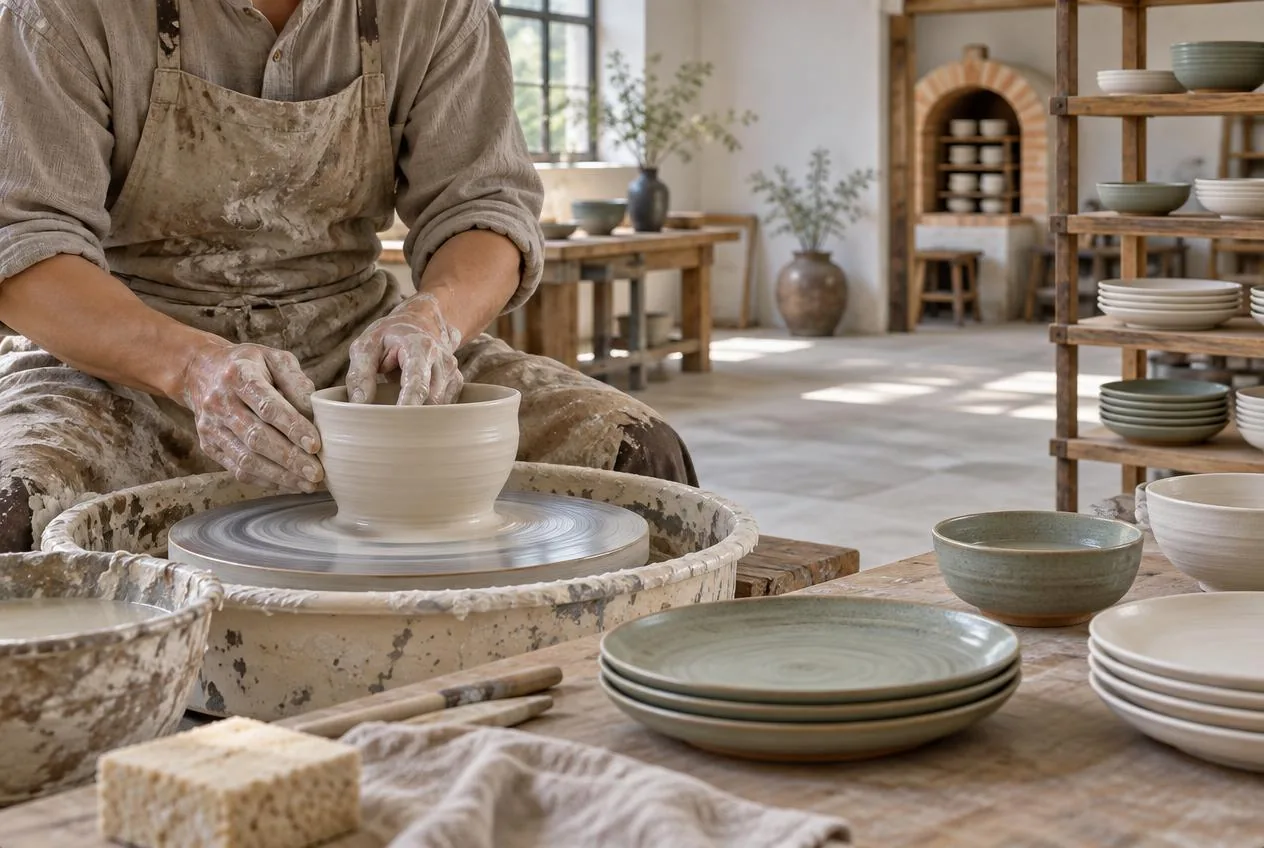
Two white plates can look identical on a product page and behave completely differently after six months of dishwashing. The difference is usually inside the kiln: how hot the body fired, and whether it vitrified fully. This article explains firing temperature in buyer's terms — what it changes, what it costs, and what to ask a supplier before you commit.
Buyers rarely see kiln parameters. They see weight, whiteness, price and, eventually, complaints. But firing temperature is the single process variable with the widest reach across all of those outcomes, which is why serious suppliers talk about it and casual ones avoid the subject.
What actually happens inside the kiln
Ceramic bodies start as mineral particles held together by water. As temperature rises, two things happen: first the water and organic material leave, then — above roughly 1000°C — the body begins to sinter and a glass phase forms between the particles. The higher and longer the soak within the body's tolerance, the more that glass phase fills the pores between particles. A fully vitrified body has closed most of its open porosity; a low-fired body still drinks water like a hard biscuit.
This is not a cosmetic difference. Water absorption governs whether a plate takes on coffee stains, holds odors, swells and cracks in the dishwasher, or survives a refrigerator-to-oven move. It also governs strength: a glass-bonded body resists edge impacts far better than a porous one of the same shape.
The temperature bands buyers encounter
| Body | Typical firing band | What it means at the table |
|---|---|---|
| Fine white porcelain (high-fired) | 1280–1380°C, fully vitrified | Bright white, low water absorption, thin edges possible, dishwasher-tough |
| Bone china | Around 1380°C | Translucent, very light, premium finish — and the least forgiving window to fire |
| Stoneware | Mid-to-high range, generally below the top of the fine-porcelain window | Vitrified but opaque and thick-walled; carries rustic glazes well |
| Earthenware | Lower range, body remains porous | Decorative and low cost, but absorbs water; needs careful use limits |
The exact band a factory uses is a legitimate buyer question. A supplier who answers precisely — and can show the body matching a golden sample — is telling you they control the process rather than buying whatever kiln time is available.
What high firing buys you
Density is the headline. At 1280–1380°C a fine porcelain body approaches negligible water absorption, which translates directly into service behavior: the glaze and body stay white instead of greying, flavors do not migrate into the plate, and the piece tolerates repeated thermal shocks from commercial dishwashing. High firing also lets a factory roll thinner rims and footrings without sacrificing strength, cutting shipping weight per set — a real saving when freight is priced by weight.
Glaze quality benefits too. Glazes mature alongside the body; in a high-fired window they melt into a harder, more scratch-resistant surface. And for decorated lines, high firing is what makes underglaze decoration possible: pigment has to survive temperatures near 1300°C and be sealed under molten glaze, a structural food-safety advantage that lower-fired decoration cannot offer.
What high firing costs
The first cost is energy. Fuel is a major line item in ceramic production, and every extra hundred degrees is paid for in every firing. The second is reject risk. Near the top of the range, wide flat forms want to slump and warp; tall cylinders can distort. Factories manage this with kiln furniture, slower cycles and shape-specific support, but a difficult shape in a high-fired body will always carry more loss than the same shape fired lower.
There is also a color constraint that surprises buyers: many bright decoration colors simply cannot survive a 1300°C window. That is one reason classic high-fired decoration leans on cobalt blue and iron tones, while vivid overglaze colors are applied later in a second, lower-temperature firing. When a catalog shows a neon palette on "high-fired porcelain," treat it as a question to ask, not a fact to accept.
Six questions to ask before you order
- What firing band does this body use? A specific answer — for example 1280–1380°C for fine porcelain — signals process control.
- Is the piece fired once or twice? Most glazed tableware is biscuit-fired, then glazed and glost-fired; decorated pieces may carry a third decoration fire. Know how many cycles your price includes.
- What does the golden sample bind you to? The approved sample should fix body weight, rim thickness and glaze surface, not just color.
- How is kiln position variation handled? Front, top and center of a kiln fire differently; ask how the factory evens this out across an order.
- What defect rate is typical for this shape at this temperature? Flat wide plates near the top of the range warp more; an honest supplier will say so.
- Can inspection results be shared before shipment? Pre-shipment checks catch warping and glaze faults while they are still the factory's problem.
Verifying claims without a laboratory
You do not need a lab to sanity-check firing claims. Weigh the piece: for the same shape, a dense high-fired body feels solid rather than chalky. Tap the rim gently and listen: a vitrified body rings clear, while porous bodies dull thud. Run a finger inside the footring: a well-fired piece is smooth and fully glazed where specified. Then put samples through the harshest realistic week you can simulate — dishwasher, stacking, daily plating — and inspect against the golden sample.
For anything food-safety related, hand the technical verification to professionals. Our quality and compliance team arranges third-party migration testing against the limits your destination market applies, and our OEM program documents body and firing specifications in the sample file so every reorder is bound to the same standard. If you are building a program from scratch, the catalog shows which bodies are available as open models, which shortens the path to a first order.
Frequently asked questions
Does higher firing temperature always mean better tableware?+
Higher firing within a body's designed range improves density, whiteness and durability. But it also narrows decoration options, raises energy cost and increases warping risk on flat shapes. The right question is whether the body is fully fired within its window — not whether the number is the highest.
Why do some plates absorb stains if they are called stoneware?+
Stoneware should be vitrified, but under-firing or an unsealed footring leaves open pores. Check that unglazed areas are smooth and request water-absorption figures or a golden sample you can test yourself with a week of wet stacking.
Is bone china fired hotter than ordinary porcelain?+
Bone china fires at around 1380°C, at the very top of the range that fine porcelain occupies. That demanding window is one reason bone china commands its premium and why its production sits with experienced kilns.
How can I tell under-firing from normal wear in returned stock?+
Under-firing shows early and broadly: greyed edges, staining that will not wash off, and rims that chip in clean flakes with a dull sound. Normal wear concentrates on contact points after long service. A tap test against your golden sample separates the two quickly.