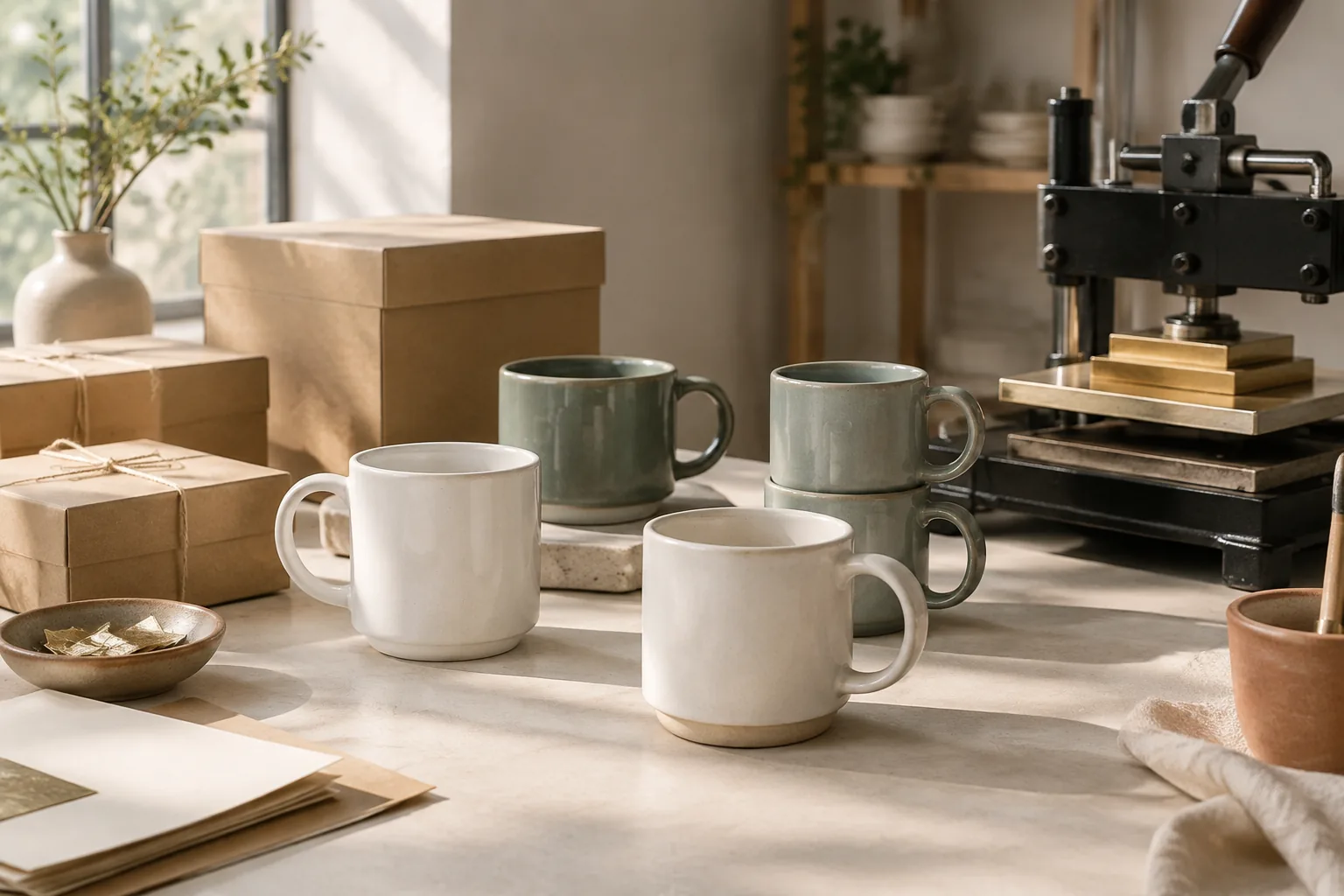
Private label is where ceramic selling stops being arbitrage and starts being a brand, but the jump from reselling stock to owning a branded line is full of quiet traps: minimums that triple, glaze colors that drift, and designs that end up in someone else's catalog. This guide maps the full path for ecommerce brands, wholesalers and hospitality groups building their own dinnerware line.
A dinner set is one of the hardest products to brand well. It is heavy, fragile, made in a craft-adjacent process where two kilns never fire identically, and sold in sets whose composition customers argue about. That difficulty is also the moat: a tableware line that survives two reorder cycles is a business competitors cannot copy with a screenshot. What follows is the complete structure — the customization tiers, the volumes that make them work, the specification discipline, and the paperwork that keeps the line yours.
Three tiers of customization, three different businesses
In ceramics, "private label" is not one thing. It is a ladder, and each rung changes your cost, your lead time and your risk.
| Tier | What you change | Typical MOQ per SKU | What it buys you |
|---|---|---|---|
| Decoration on an open model | Logo decal, printed pattern or packaging on an existing shape | 500 pieces (typical, stock programs) | Brand presence at the lowest capital and fastest sampling |
| Custom glaze and colorway | A developed glaze color and finish applied to existing forms | 1000–3000 pieces (typical) | A recognizable palette competitors cannot order from a catalog |
| Custom form and mold | Your own shapes, developed from drawing to production molds | 1000–3000 pieces (typical) | A defensible design identity, but tooling, timeline and IP clauses to manage |
Honest advice for a first line: start at tier one or two. A distinctive glaze palette on well-chosen open forms delivers most of the shelf recognition at a fraction of the risk. Reserve full mold development for the hero pieces that define the brand — usually one or two forms, not the whole range. Our OEM and ODM program is structured around exactly this ladder, so you can step up a tier as the line proves itself instead of betting everything on round one.
The volumes that make it work
Stock programs start around 500 pieces per SKU because the factory is amortizing nothing — the form, the glaze and the packaging already exist. Custom programs run at a typical 1000–3000 pieces per SKU because the factory must recover setup work: mold sets or decal screens, a dedicated glaze batch, and kiln space that must be planned around your order. This is not a negotiable tax; it is the real cost of the kiln stopping its standard run to serve a line only you sell.
The practical consequence for line planning: every shape is its own SKU with its own minimum. A twelve-piece set built on four shapes at a 1000-piece minimum is 4,000 pieces, not 1,000. Brands that understand this early design tighter lines — fewer shapes, more decoration depth — and reach launch with half the capital of brands that discover it from a pro forma invoice.
The specification ladder
A private label order is a specification document with a purchase order attached. Weak specs produce beautiful samples and disappointing shipments. Work down the ladder and fix each layer in writing.
- Body. High-fired porcelain fired in the 1280–1380°C window for everyday programs, stoneware for a heavier, rustic positioning, bone china (fired around 1380°C) for premium and gift tiers. The body decision drives weight, chip behavior and freight cost everywhere downstream.
- Glaze. Finish (gloss, matte, reactive), the colorway, and the variation band you will accept. Reactive glazes vary piece to piece by design — agree on what "within range" means before production, not after.
- Decoration. Decal, stamping, hand-paint or emboss, and — critically — where it sits relative to the glaze, because decoration in the food-contact zone must meet migration limits.
- Set architecture. Which pieces compose the set, and whether open-stock replenishment is part of the plan.
- Packaging. Protective structure first, branded surface second — never the reverse.
Golden samples are the brand
In private label, the golden sample is not a formality — it is the physical constitution of your brand. Every future reorder will be judged against it, so the discipline around it matters more than any design rendering.
- Approve on fired, glazed, fully decorated production-condition pieces — never on unfired blanks or renderings.
- Seal two identical sets: one with the factory, one with you, cross-referenced by date and batch.
- Record the specification alongside the sample: dimensions in mm, capacity in ml, glaze code, decoration placement, body type.
- For reactive or handmade effects, approve a band — a set of samples spanning the acceptable range — rather than a single piece.
- Reference the golden sample explicitly in the purchase order as the acceptance standard.
The sample you approve is the product you will keep receiving. Approve casually and you have rebranded your brand as whatever the kiln felt like that week.
Compliance is brand protection
A branded dinnerware line inherits every food-contact obligation of the destination market, and a brand is exactly the entity regulators and plaintiffs pursue. Build compliance into the line from the first sample, not as a pre-shipment scramble.
For the US market, ceramic tableware falls under FDA 21 CFR 109.16, which limits lead leached in a 4% acetic acid solution — 3.0 µg/mL for flatware, 2.0 for holloware, 0.5 for cups and mugs — with cadmium enforcement levels of 0.5 and 0.25 µg/mL respectively under CPG 545.400, tested by ASTM C738. For the EU, EC 84/500/EEC sets migration limits of 0.8 mg/dm² lead and 0.07 mg/dm² cadmium for flatware, and 4.0 / 0.3 mg/dm² for storage vessels, with CE marking and a declaration of conformity added by Directive 2005/31/EC. German retail runs tighter under LFGB. Underglaze decoration and lead-free glaze systems are structurally lower-risk choices for the food-contact zone, which is why so many serious private label programs specify them. Third-party test reports are available upon request for any program we develop — ask for them by standard number, and read our compliance overview before you finalize a spec.
A phased roadmap that survives contact with reality
| Phase | Move | Why this order |
|---|---|---|
| 1. Prove demand | Stock forms, your decoration and packaging, ~500-piece SKUs | Tests your positioning and photography with the least capital at risk |
| 2. Own a palette | Custom glaze development on winning forms, 1000–3000 pieces | Locks the visual identity customers actually repeat-purchase |
| 3. Own a form | Mold development for one or two hero shapes | Concentrates tooling spend where design identity is worth defending |
| 4. Deepen the line | Extend shapes and sets around the proven core | Every addition reuses established glaze and quality infrastructure |
The sequence matters because each phase generates the sales data and golden-sample infrastructure the next one depends on. Brands that invert it — molds first, demand evidence later — tend to own beautiful tooling for products nobody reordered.
If you are planning a line, bring us the positioning and the target market and we will propose the tier, the set architecture and an honest volume. Send a quotation request with your set composition, and browse the dinnerware set categories to see how open models can carry your brand before you commit to tooling.
Frequently asked questions
Can I private label ceramic dinnerware with just my logo on stock pieces?+
Yes, and it is the sensible first step. A logo decal and branded packaging on an existing form typically runs at the stock-level minimum of around 500 pieces per SKU, because no form or glaze development is involved. It tests your brand with real customers before you fund custom development.
Why do custom ceramics need 1000–3000 pieces when some sites advertise lower?+
Custom work consumes real factory resources before the first saleable piece exists: glaze trials, decal screens or mold sets, and kiln scheduling. Suppliers quoting very low minimums for full custom work usually recover the difference elsewhere — in unit price, in skipped development steps, or in a design that quietly reappears in their catalog.
How long does a private label dinnerware line take from brief to shipment?+
Decoration on open models moves in weeks; custom glaze and mold development adds sampling and correction loops, so months is the honest planning unit for a full line. Agree the timeline phase by phase, with the golden sample approval as the gate between development and production.
Do I need different compliance for the US and EU versions of the same line?+
The strictest practical route is to design to the toughest market once. EU limits under EC 84/500/EEC and German LFGB expectations are tighter than US FDA 21 CFR 109.16 on lead and cadmium migration, so a line built to EU limits typically clears US requirements as well — always confirmed by test reports rather than assumption.
Who owns the design if I fund a custom mold?+
Whatever the contract says, so put it in the pro forma invoice: mold ownership, exclusivity scope and term, and the right to have molds released to you or a named kiln. Silence on these points is how exclusive designs become factory catalog items.