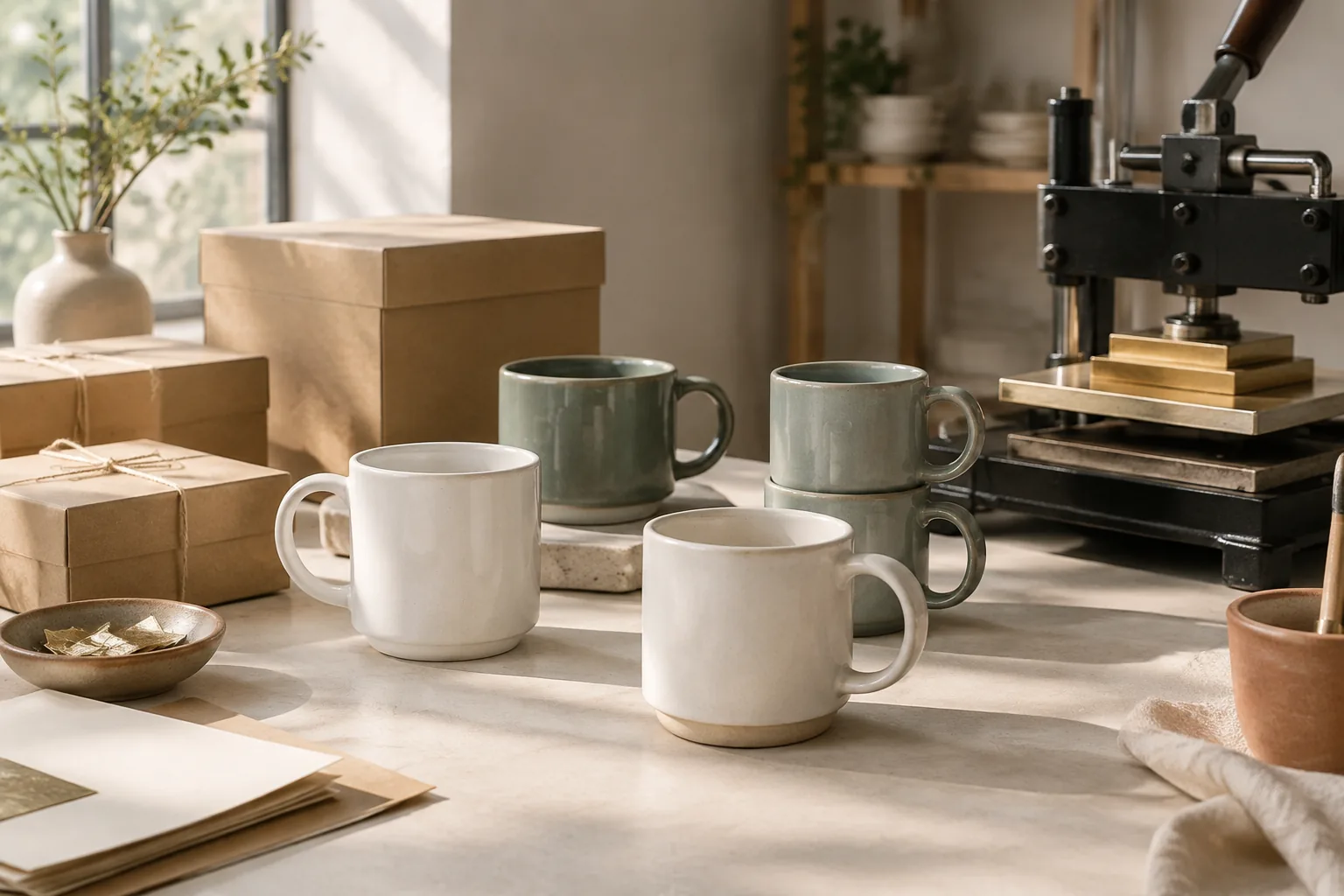
A logo is the most common first step into custom ceramics, and the method you choose for applying it decides how the mark wears, what it costs, and whether it survives the dishwasher and the regulator. This article compares decal, etching, stamping and hand-paint in buyer's terms, so you can match the method to your brand position before you order samples.
Most buyers meet logo options as a price list from a salesperson: decal adds this, hand-paint adds that, no further explanation. That is backwards. The application method is a product decision with consequences for durability, food-contact compliance and reorder consistency — and the right answer differs for a café mug program, an ecommerce gift set and a hotel brand standard.
The four routes at a glance
| Method | How it is done | Best suited to | Watch-outs |
|---|---|---|---|
| Decal (transfer) | A printed transfer is applied to the piece and fired to bond it; available over-glaze, in-glaze or under-glaze | Multi-color logos, fine detail, consistent reproduction at volume | Position matters for food contact; screen setup per design at order time |
| Etching / sandblast finish | A masked area of the glazed surface is blasted to a frosted texture | Subtle, tactile monochrome marks on thicker glazed bodies | Reads as texture rather than color; least suited to fine detail |
| Stamping | A carved or rubber stamp applies pigment by hand, then the piece is fired | Artisan positioning, imperfect charm, small marks | Deliberate variation piece to piece; alignment and ink coverage drift |
| Hand-paint | An artist paints the mark or motif freehand before or after glazing | Premium and heritage lines, one-of-a-kind character | Slowest and most variable; budget for an approved variation band, not uniformity |
A fifth option deserves mention: forming the logo into the piece itself — embossed or debossed in the mold. It cannot chip off because there is nothing applied, and it survives any dishwasher. Its limit is that it changes the tooling, which puts it closer to mold development than decoration; it fits when the mark is the product, not a garnish on it.
Durability: what actually wears a logo away
The enemy of a decoration is not water but abrasion and chemistry — years of dishwasher cycles, scouring pads and cutlery contact. How a mark is positioned relative to the glaze largely decides its fate:
- Under-glaze decoration is applied to the body and sealed beneath the glaze layer. The color never contacts food or a scouring pad, which makes it the structurally most durable and most food-safe position.
- In-glaze decoration sinks into the glaze during firing. It integrates well but softens fine detail slightly.
- Over-glaze decoration sits on top of the fired glaze and is bonded by a lower-temperature firing. It delivers the finest detail and brightest metallics — gold rims live here — but it is the position most exposed to wear, and the one regulators watch most closely.
Practical rule: marks that will meet cutlery and dishwashers daily belong under or in the glaze. Reserve over-glaze work for zones a spoon never touches, such as the outside of a mug wall above the rim line or the foot of a plate display side.
Food contact: the rules your logo must clear
A logo printed inside a bowl is a food-contact surface, and both major regulatory systems treat it that way. In the US, FDA 21 CFR 109.16 limits lead leached from ceramic tableware in 4% acetic acid — 3.0 µg/mL for flatware, 2.0 for holloware, 0.5 for cups and mugs — with cadmium enforcement levels under CPG 545.400 and testing by ASTM C738. In the EU, EC 84/500/EEC sets migration limits of 0.8 mg/dm² lead and 0.07 mg/dm² cadmium for flatware and 4.0 / 0.3 mg/dm² for containers, with CE marking and a declaration of conformity added by Directive 2005/31/EC. Decoration — especially over-glaze enamels and metallics — is where these elements historically enter the picture, which is why serious programs demand migration test reports for the decorated final piece, not just the bare body.
Underglaze decoration and lead-free glaze systems are structurally lower-risk in the food-contact zone, and that is a specification you can write into the purchase order. Ask for test reports against the exact standards by number — ours are available on request, and the compliance page explains the document set in full.
What each method does to your order
| Factor | Decal | Etching | Stamping | Hand-paint |
|---|---|---|---|---|
| Detail fidelity | Highest — fine lines and small type hold | Low — bold marks only | Medium — character varies by pressure | Variable by artist |
| Reorder consistency | High once the transfer is approved | High — mask controls placement | Inherent variation | Inherent variation |
| Position vs glaze | Choice of under, in or over | Surface texture after glazing | Typically under or over | Either, declared per design |
| Volume fit | Scales cleanly | Scales with masking labor | Labor-bound, modest volumes | Labor-bound, premium tiers |
| Typical program MOQ | 500 pcs stock forms; 1000–3000 pcs custom | Follows the form's MOQ | Follows the form's MOQ | Custom tiers, 1000–3000 pcs typical |
Note the pattern in the last row: decoration methods ride on top of the form's minimum. A logo decal on an open-model mug follows the stock program minimum of around 500 pieces; a bespoke form carrying that same decal enters the typical 1000–3000 piece range for custom work, because the form itself is now a development project. Our custom program quotes both paths side by side so the trade-off is visible.
Matching method to brand position
- Hospitality and high-turn cafés: under-glaze decal or embossed marks on a durable body — the logo must outlive hundreds of dishwasher cycles and constant tray stacking.
- Ecommerce brands scaling a hero mug: decals for fidelity and reorder consistency, with the mark placed outside the food zone for simpler compliance — see the mugs and cups range for open models that accept decoration immediately.
- Artisan and studio-positioned lines: stamping or hand-paint, with the variation declared as a feature and bounded by an approved band of samples.
- Premium gift and wedding programs: hand-paint or over-glaze metallic decals on zones away from cutlery, paired with presentation packaging.
Send us your logo file, the intended placement and the target market, and we will recommend a method with sample costs before you commit. Start at the quotation page and reference the product family you have in mind.
Frequently asked questions
Which logo method lasts longest in a commercial dishwasher?+
Decoration sealed beneath the glaze — under-glaze decals, in-mold embossing or in-glaze work — outlasts surface-applied decoration in abrasive, high-temperature dishwashing. Over-glaze decals, including metallics, belong on zones cutlery and sponges cannot reach.
Can my logo go inside the bowl or on the rim?+
Technically yes, but any decoration in the food-contact zone must meet the applicable migration limits — FDA 21 CFR 109.16 in the US, EC 84/500/EEC in the EU — verified by testing the finished, decorated piece. Most brands place marks on outer walls or undersides to simplify compliance without constraining design.
Why does a one-color logo still need setup if decals are printed?+
Ceramic decals are screen-printed, and each color in the design requires its own screen before the transfer sheet exists. The setup is a one-time cost per design; reorders reuse the approved screen, which is why repeat pricing improves after the first run.
Will hand-painted logos look identical across a 1000-piece order?+
No, and pretending otherwise creates disputes. Hand application varies by artist, stroke and firing. Approve a variation band — several samples spanning the acceptable range — and reference that band in the purchase order instead of a single perfect piece.