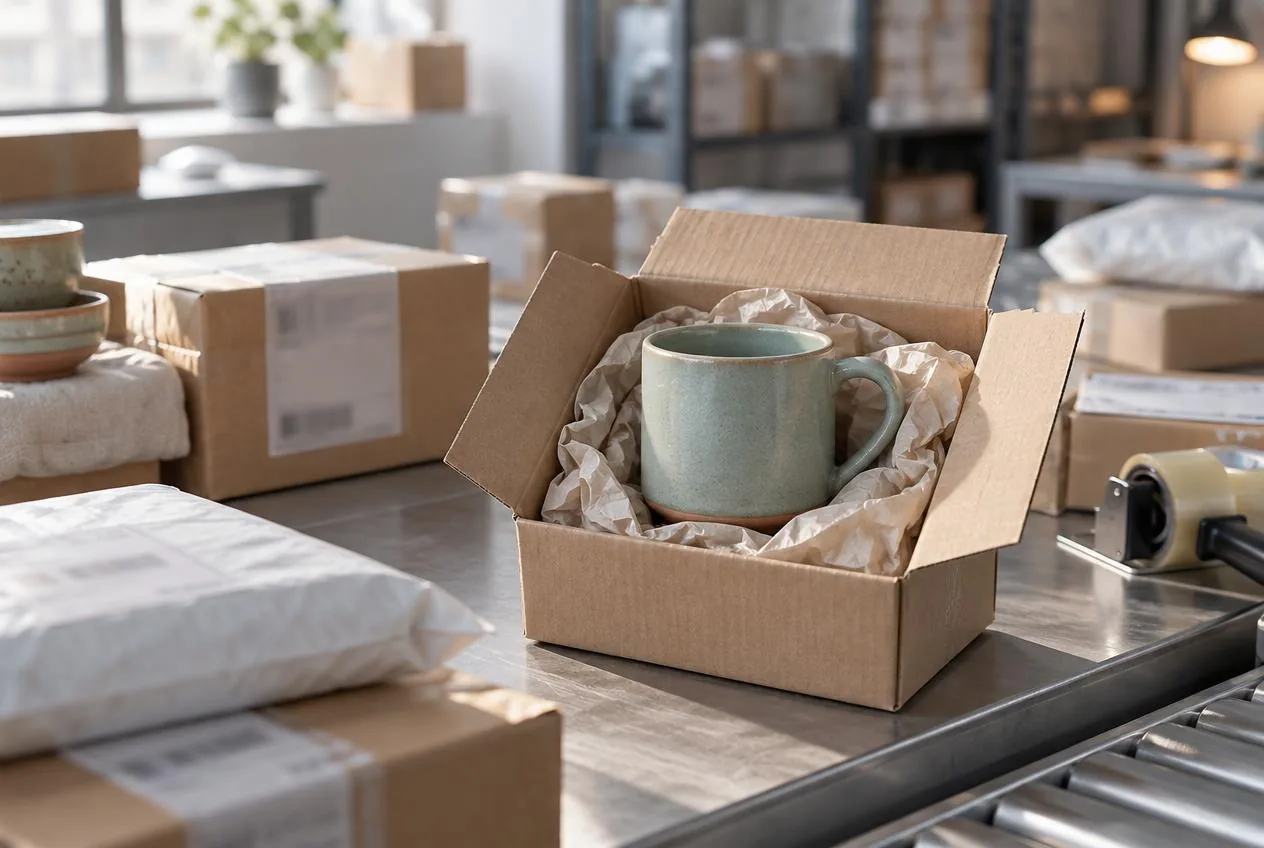
Ceramics dropshipping — selling tableware online while a supplier ships each order directly to your customer — is one of the harder versions of an already demanding business model. Fragile goods, real freight weight and post-2025 duty rules compress the margins that a generic dropshipping calculator tends to promise. This guide explains how the model actually works for tableware, what the unit economics look like line by line, and which operating disciplines separate a durable store from a refund queue.
What ceramics dropshipping actually involves
In a ceramics dropshipping arrangement you hold no inventory. A supplier — in practice, a manufacturer or export trader with stock programs — holds the goods, and ships individual customer orders on your behalf, usually under blind packing so the parcel carries no trace of the factory. You run the storefront, the marketing and the customer service; the supplier runs picking, protective packing and dispatch.
It differs from light-goods dropshipping in one structural way: there is no endless catalog to resell. A ceramics supplier takes orders against stock items at a typical MOQ of 500 pieces per SKU, against golden samples you approved in advance. You are not listing someone else's feed; you are building a small brand on top of a manufacturing relationship. That is more work at the start and far more defensible later.
Why ceramics punish the standard dropshipping playbook
- Fragility is a permanent cost line. Industry and insurer estimates put damage rates for fragile goods without professional packing at roughly 5–8%. Every damaged parcel destroys not just the product cost but the packaging, the freight and the duty paid on it.
- Freight scales with weight. Ceramics are heavy relative to their value, and couriers price by actual or volumetric weight, whichever is higher. Freight is never a rounding error in this category.
- Duty can no longer be ignored. The US suspended the $800 de minimis exemption on 29 August 2025 (Executive Orders 14324 and 14388), so every US-bound parcel now clears with duty paid. In the EU, a single 79.0% anti-dumping duty has applied to Chinese ceramic tableware since 7 February 2026 under Regulation (EU) 2026/274.
- It is a food-contact product. Ceramic tableware carries lead and cadmium migration limits — FDA 21 CFR 109.16 in the US, EC 84/500/EEC in the EU. A compliance problem follows the parcel to the customer's kitchen, not to a warehouse shelf.
Unit economics, line by line
The honest way to evaluate this category is to price one order fully before writing a single product page. The table below is an illustrative cost stack for a 16-piece porcelain dinnerware set at a 500-piece MOQ, shipped as a single parcel to a US customer — it is not a quotation, and your actual numbers will differ, but the structure is what matters.
| Cost line | Illustrative amount | What drives it |
|---|---|---|
| Goods cost (16-piece set, 500 pcs MOQ) | $16.00 | Body type, decoration, MOQ tier |
| Protective packaging | $2.40 | Per-piece wrap, air columns, 5-ply carton |
| Air freight DDP share (US, 5–10 days) | $9.50 | Weight, volumetric rules, fuel cycles |
| Duty and brokerage (DDP) | $3.20 | Section 301 List 3 at 25% plus current layers |
| Breakage reserve (≈6% of the above) | $1.90 | Baseline 5–8% fragile-goods loss rate |
| Landed cost per delivered order | ≈ $33.00 | Before platform fees and marketing |
Read the table for its ratio, not its absolute numbers: packaging, freight, duty and breakage together can rival the goods cost itself. That is why acquisition strategy decides viability. A store selling to an audience it already owns — repeat buyers, search traffic, a community — can carry this stack. A store buying cold paid traffic for a heavy, fragile product usually cannot, because the advertising cost sits on top of an already tall cost structure.
One lever changes the freight line dramatically: once a SKU proves velocity, moving reorders from per-parcel air to consolidated sea freight (about 15–25 days to the US on express sea services, or 18–35 days by rail to Europe at roughly a third of air cost) resets the economics. The model that survives is rarely pure parcel dropshipping forever — it is parcel-first, then staged.
Three fulfillment models compared
| Model | How it runs | Best suited for |
|---|---|---|
| Direct DDP parcels from China | Supplier packs and ships each order; forwarder clears duty under one landed rate | Launch phase, samples, low-velocity SKUs |
| Overseas warehouse | Bulk import with duty paid once; domestic last-mile dispatch | Proven SKUs with steady weekly velocity |
| Hybrid staging | Bulk stock at a third-party warehouse, parcel overflow direct from the factory | Seasonal peaks and mixed catalogs |
The international postal path that defined early dropshipping is effectively closed for US-bound parcels now that duty attaches at entry. Every model in the table clears customs formally; the difference is who pays duty, once or per parcel. Our dropshipping operations hub walks through the switching criteria in detail.
The supplier checklist that filters out most trouble
- A written packaging spec: per-piece honeycomb or bubble wrap, air-column cushioning, five-ply outer cartons — and individual packing with a 125 cm drop standard (face, edge, corner) if parcels ever go to platform warehouses.
- A duty-inclusive DDP rate card, with the duty line named separately so you can verify it.
- A damage replacement clause: a stated claim window, a photo-based evidence process, and replacement stock shipped without re-invoicing.
- Blind-packing confirmation in writing: no factory name, no invoice, no supplier branding in the parcel.
- Stock depth commitments per SKU, so a selling week does not turn into a stockout apology.
- Food-contact documentation available on request — third-party lab test reports against FDA 21 CFR 109.16 and, for Europe, EC 84/500/EEC.
- Golden sample discipline: dispatch should match the approved sample, not a rotating interpretation of it.
Suppliers who refuse to put the packaging spec and replacement clause in writing are telling you where their loss rate lands — on your side of the table. The shipping and packaging standard we operate under exists precisely because 5–8% baseline damage is a choice, not a law of nature.
Compliance you cannot delegate away
Even when the supplier ships every parcel, the regulatory exposure follows the product. US enforcement under FDA 21 CFR 109.16 works with lead action levels of 3.0 µg/mL for flatware, 2.0 for holloware and 0.5 for cups and mugs, with cadmium enforced at 0.5 and 0.25 µg/mL respectively under CPG 545.400, tested by ASTM C738. The EU framework under EC 84/500/EEC sets migration limits per surface area, with CE marking and a declaration of conformity added by Directive 2005/31/EC. You do not need to run the labs yourself, but you do need reports on file before the first order ships — decoration choice matters here, because underglaze decoration is structurally lower-risk for lead and cadmium migration than overglaze color.
When the model makes sense — and when it does not
Ceramics dropshipping fits sellers who bring their own demand: an existing audience, a content engine, a retail brand extending online, or a gift and hospitality niche with repeat occasions. It fits mid-ticket sets better than single commodity mugs, because sets concentrate value per parcel and spread freight across more pieces.
Ceramics dropshipping does not fail because the product is bad. It fails because sellers import a software-era playbook into a category where every parcel has weight, duty and a nonzero chance of arriving in pieces.
It does not fit sellers looking for a zero-touch catalog with no samples, no MOQ and no packaging standard — that product no longer exists in this category, and pretending otherwise is how 5–8% damage rates and unexpected duty bills end stores. If you want the honest version of the numbers for your own catalog, request a quote and ask that the duty and breakage lines be shown separately.
Frequently asked questions
Is ceramics dropshipping still viable after the de minimis change?+
Yes, but only on duty-inclusive terms. Since 29 August 2025 every US-bound parcel clears customs with duty paid, so landed cost must be priced into the retail price from day one. Sellers who reprice honestly and move proven SKUs to consolidated freight remain profitable; those who pretend duty does not exist do not.
What MOQ should I expect for a dropshipping program?+
For stock items, a typical MOQ is 500 pieces per SKU, which is what makes the supplier a real manufacturing relationship rather than a marketplace feed. Custom decoration and private label programs typically run 1000–3000 pieces per SKU.
Who pays when a parcel arrives broken?+
Whoever the replacement clause says pays — which is why the clause must exist before the first order. Professional packing holds damage well below the 5–8% fragile-goods baseline; a workable program agrees a photo-based claim window and replacement stock shipped without re-invoicing.
Do I need my own food-contact test reports if the supplier ships?+
You need reports on file, whichever party commissions the testing. FDA 21 CFR 109.16 sets the US lead and cadmium action levels and EC 84/500/EEC sets the EU migration limits; ask for third-party lab reports against the applicable standard before listing, and prefer underglaze decoration where risk tolerance is low.