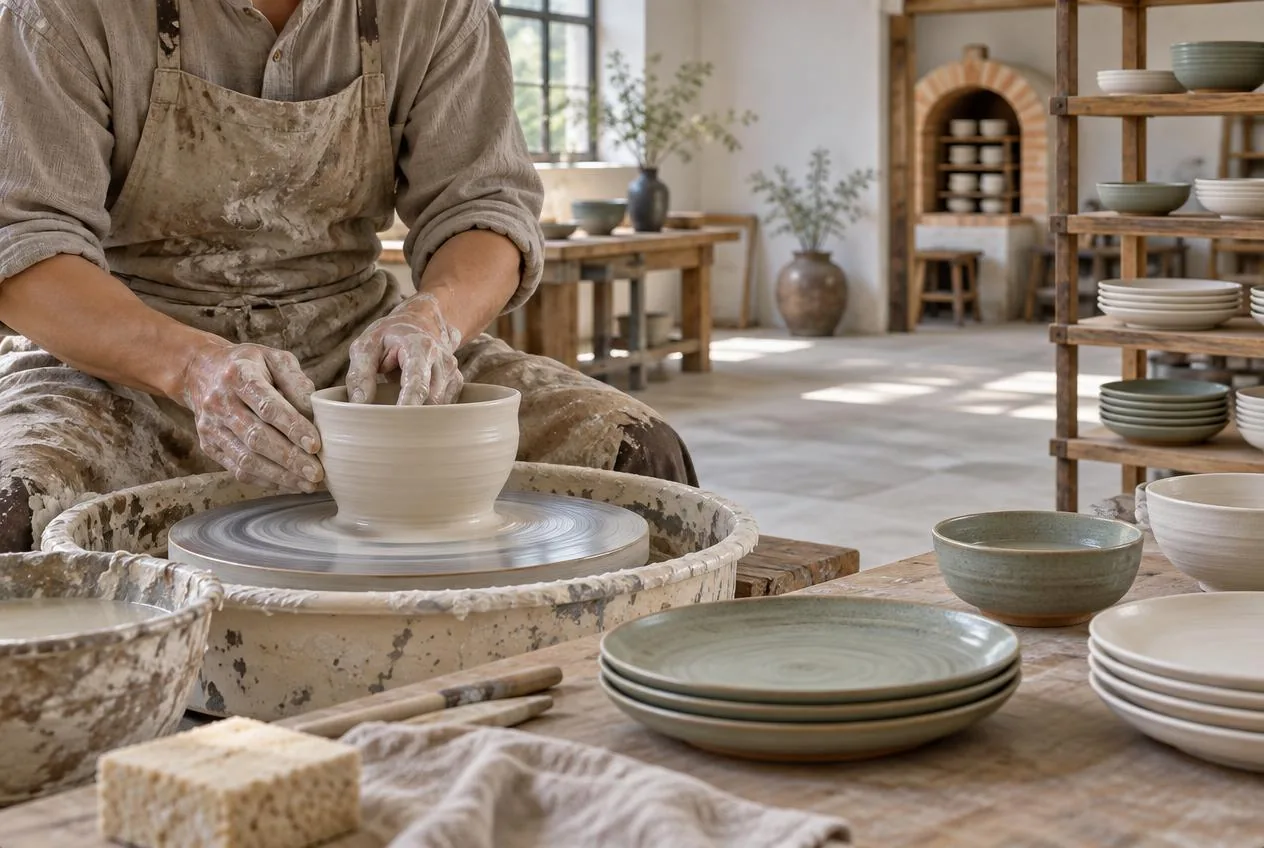
A custom ceramic shape starts life as a plaster mold, and the quality of that mold decides the quality of every piece you ever ship. This article walks the mold development sequence step by step, shows where the money and the delays actually come from, and lists the contract clauses that keep your design yours.
Buyers meet mold development at its worst moment: eight weeks in, behind schedule, with a first trial that looks nothing like the rendering. Almost every such failure traces back to a skipped stage or an unwritten assumption early on. The sequence below is how experienced programs run it instead.
First: do you actually need a new mold?
There are three tiers, and the cost difference between them is large. Tier one is an open model — a shape the factory already produces, restyled only by glaze and decoration. It needs no mold investment and starts at a typical MOQ around 500 pieces per SKU. Tier two is a modification — changing a footring, deepening a well, adjusting a handle on an existing model. This needs partial rework and lands in the middle on cost and time. Tier three is full development — a new form from drawing to production molds, which carries tooling cost, the longest timeline and the typical 1000–3000 piece per SKU volume that makes the investment rational.
Honest programs push buyers down a tier when the commercial goal allows it. A decoration change on an open model often delivers ninety percent of the brand differentiation at a fraction of the risk. Reserve tier three for forms that carry your design identity.
The development sequence, step by step
- Design freeze. Dimensions, wall thickness, footring, handle geometry and capacity fixed in a drawing both parties sign. Changes after this point restart the clock — say so in the agreement.
- Master model. The shape is made at full size, accounting for the shrinkage the body will undergo in drying and firing. Shrinkage assumptions differ by body, so the master is always body-specific.
- Working molds. Plaster molds are cast from the master — the negative forms that will receive slip or press clay in production. The number of mold sets depends on your volume plan; they wear and are consumables.
- First trials. Pieces are formed, dried, glazed and fired in the real production body and glaze. This is where reality arrives: warping on wide flats, glaze pooling where the drawing expected none.
- Correction loops. Measurements against the drawing, adjustments to the master or molds, and another trial. This loop — not mold making itself — consumes most of the calendar.
- Golden sample lock. The final approved piece, retained at both ends with its measurement record, becomes the binding standard for every future run.
Measured honestly, the sequence runs in weeks to a few months depending on shape complexity and how many correction loops the geometry demands — a stackable cup converges far faster than a wide, flat, rim-rolled platter. What kills timelines is not any single step but unbounded loops, which is why the drawing freeze and a defined correction budget belong in the contract.
Where the money goes
| Cost driver | Why it moves the number |
|---|---|
| Size and format | Large platters need bigger molds, more kiln furniture and gentler firing curves |
| Pieces per set | A 16-piece program multiplies every development task by the number of distinct shapes |
| Handles and relief | Complex undercuts and attached parts require multi-part molds and more hand finishing |
| Body choice | Bone china and high-fired porcelain tolerate less, so trials and rejects cost more |
| Correction rounds | Each loop consumes mold rework and another trial firing |
| Exclusivity | A mold reserved for your brand alone carries the opportunity cost the factory prices in |
The risk register
| Risk | Symptom you will see | Mitigation |
|---|---|---|
| Shape drift | Production pieces measure small, or rims flare where the drawing is vertical | Sign the drawing; measure first trials against it, not by eye |
| Glaze misbehavior | Pooling, dull patches or color breaks on the new geometry that samples did not show | Trial in the exact production glaze; adjust glaze or relief together |
| Warping on flats | Platters rock on a flat counter after firing | Rim and footring redesign; body or firing-curve adjustment before scaling |
| Mold wear on long runs | Later batches lose edge sharpness against the golden sample | Agree a mold-refresh cadence and who pays for replacement sets |
| Design leakage | A near-identical form appears in the factory's open catalog | Written exclusivity on the shape, with scope and term defined |
Contract clauses that protect you
- Tooling ownership and buyout: state who owns the molds, what a buyout costs, and that molds ship to you or a named kiln on request.
- Exclusivity scope: define the protected shape precisely, the markets it covers, and the term — silence here is how exclusive designs become catalog items.
- Golden sample supremacy: the retained sample plus its measurement record governs acceptance; verbal descriptions never do.
- Amortization transparency: know whether tooling is billed up front or recovered through the unit price, because it changes your reorder economics.
If a custom form is on your roadmap, our OEM program runs exactly the sequence above with the paperwork included, and a shaped-mug or cup development is one of the fastest ways to learn the process on a forgiving format — see our mugs and cups line for open models that accept modification. For a quotation that prices development honestly, send the drawing and the target volume together.
Frequently asked questions
Who owns the mold after development?+
Whatever the contract says, so put it in writing. Common arrangements are factory-owned with exclusivity to you, buyer-owned after a tooling fee, or buyer-owned from day one. Without a clause you own nothing — including your ability to move production.
Why did my custom mugs shrink differently from the drawing?+
Ceramic bodies contract substantially during drying and firing, and the shrinkage rate is body-specific. Masters are made oversize to compensate. If the first trial misses, the shrinkage assumption — not your drawing — usually needs recalibrating for that body.
How many correction rounds should I budget for?+
Simple round forms often converge in one or two loops; wide flat or handle-heavy forms take more. Agree a defined number of included correction rounds up front and price additional loops explicitly — it keeps both sides decisive.
Can another factory run my mold if relations break down?+
Physically, yes — plaster molds are portable and a new kiln can trial them. Contractually, only if you own or can release the tooling. That is why the ownership and buyout clause matters more than any other line in a mold agreement.