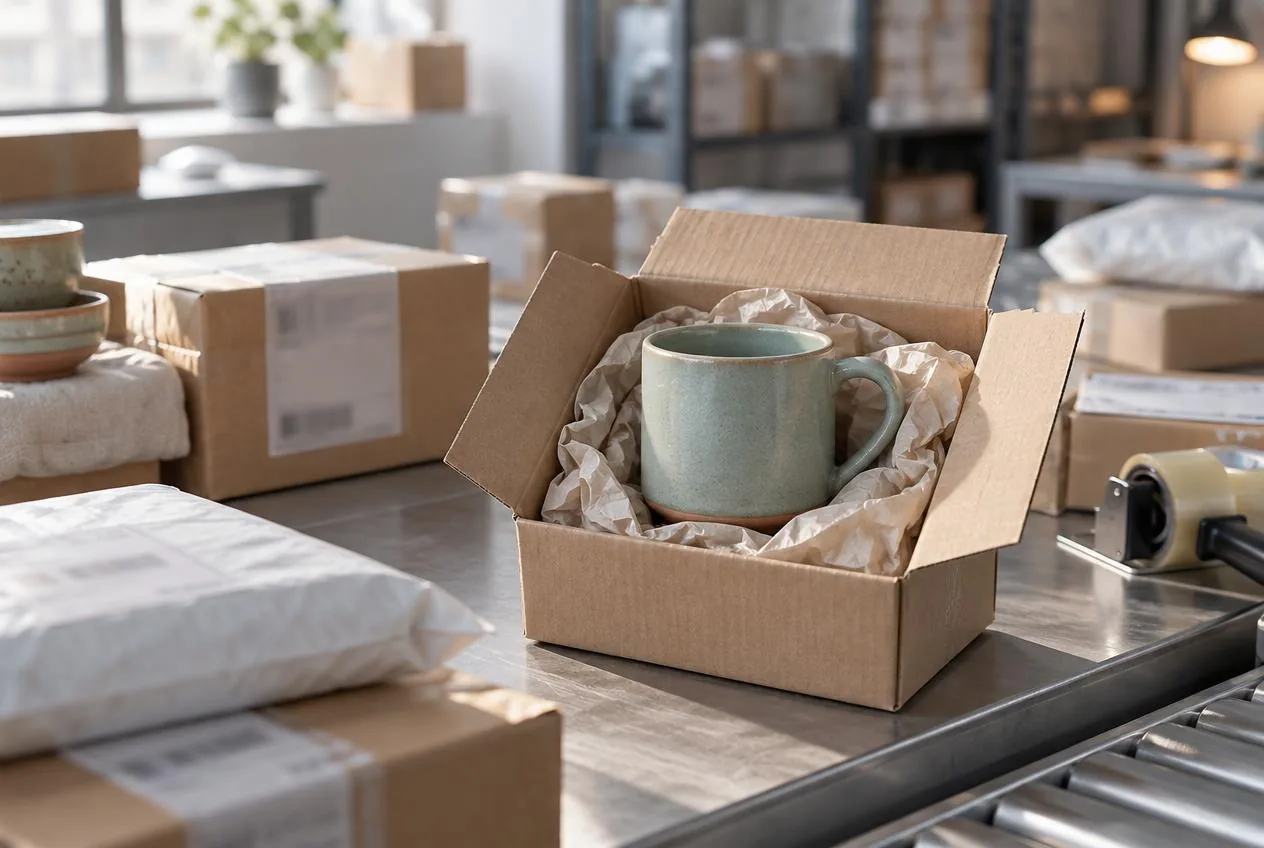
Blind dropshipping means your supplier ships orders to your customers without any trace of the factory — no invoice, no brand, no return address that points back to the source. In ceramics, where relationships are fewer and deeper than in light goods, the arrangement protects something bigger than appearances: the boundary between your customer base and your supply chain. This article covers what blind packing must actually contain, the clauses that make it enforceable, and the trust that has to run in both directions for the model to hold.
What "blind" actually covers
Blind packing is a physical and paperwork discipline, and it fails on details. A properly blind ceramics parcel contains the product in protective packaging — per-piece wrap, air columns, five-ply carton — and nothing else that identifies the source.
- No commercial invoice inside the box. Customs paperwork rides outside or electronically, never in the parcel.
- No factory name, logo or catalog on the carton, tape, or inner boxes.
- No supplier contact details on the packing slip — your store name and order reference only.
- Your insert, or no insert: if you want a thank-you card or care instructions in the box, the supplier inserts your pre-printed material, never their own.
- A neutral sender address on the label, agreed in writing — usually the forwarder's, not the factory gate.
Each item on that list exists because a customer found the loophole: the invoice with a factory letterhead, the tape printed with a brand, the care card inviting reorder direct from the source. Blind is binary — a parcel either passes the checklist or it is not blind.
The two-way information problem
Sellers usually think of blind dropshipping as protecting them from one risk: the supplier quietly selling to their customers, using the shipping data that passes through the factory every week. That risk is real and worth addressing. But the mirror risk gets less attention — the supplier's fear that a buyer will collect a golden sample, place one MOQ run, and take the design and the packing spec to the next factory down the road. Both parties hold sensitive information; both can defect.
Durable arrangements answer both fears at once. The supplier commits to blind packing, address confidentiality and no poaching, because the buyer concentrates volume and pays predictably. The buyer stops shopping every order, because the switching cost of moving a validated ceramics program — samples, packing standards, replacement SLAs — is far higher than it looks from outside. The protection is contractual on paper and economic underneath: you are worth more to each other than a single order either of you could steal.
The clauses that make blind dropshipping enforceable
- Blind-pack confirmation in writing — the checklist above, attached to the agreement, with a named responsible person at the supplier.
- Dispatch within an agreed window — a stated business-day commitment from order transmission to courier handover, so your storefront delivery promise is buildable.
- Damage replacement terms — a photo-based claim window and replacement stock dispatched without re-invoicing, aligned to the packing spec.
- Customer data confidentiality — shipping addresses used for fulfillment only, no retention beyond the claim window, no marketing use in either direction.
- Insert handling — who supplies inserts, how they are stored, and what happens when stock runs out (hold dispatch rather than ship an empty box or, worse, the supplier's card).
- Stock depth reporting — a weekly count per SKU, so blind does not mean blind-sided by a stockout.
- Audit rights — the right to receive, on request, a photo of a packed parcel against the agreed spec, and to run test orders to your own address.
Notice what is missing: any need to name your customers or your sales data. The supplier needs SKU-level forecasts, not your analytics. Sharing less than that is not distrust; it is scope discipline. The dropshipping operations hub keeps the full clause library alongside fulfillment options.
Where blind packing reaches its limits
Honesty requires saying what blind packing cannot do. Tracking pages often reveal the origin country the moment a parcel scans, and customers who see a two-week delivery window will infer an overseas supply chain whatever the box says — the goal of blind packing is a professional, neutral experience, not a geographic illusion. Returns are a second limit: a US or EU customer returning a parcel to a China address is expensive enough that replacement-first policies, and eventually a local returns address via a warehouse, usually beat routing boxes across the Pacific.
And as a store grows, the economics change under you. Per-parcel air with duty paid on every unit is how you start; consolidated sea freight at 15–25 days to the US, or an overseas warehouse holding your proven SKUs, is how you scale — the shipping options compare the lanes. At some point, the same logic that hid the factory makes you want your name on the box instead: that is the private-label decision, and it changes the MOQ conversation to 1000–3000 pieces per SKU with the OEM program.
Run a test order to yourself or a friend before the first real customer order — box, tape, inserts, packing slip, label. Every blind-packing failure we have seen would have been caught by one $30 rehearsal.
Protecting the relationship in both directions
The clause list keeps you safe on paper; behavior keeps the program safe in practice. Pay on the agreed terms — ceramics factories run on material and firing cycles, and a buyer who pays predictably gets their orders scheduled first when kiln capacity tightens before peak season. Consolidate rather than fragment: five factories sampling the same mug produces five mediocre programs, while one factory holding your volume produces priority, honesty about problems, and first look at new stock shapes. Share SKU-level forecasts so the factory can pre-fire stock before your ads ramp. None of this appears in the contract, and all of it determines whether blind dropshipping stays quiet and boring — which is exactly what it should be.
If you are setting up a blind program and want the packing standard, replacement terms and duty-inclusive rates in one schedule, request a quote and we will structure it as a reviewable agreement.
Frequently asked questions
Will my customers know the product ships from China?+
Often yes, from the delivery window and tracking scans, whatever the box says. Blind packing removes the supplier's identity from the parcel — no invoice, no branding, neutral sender — which is what actually protects your customer relationship. Position delivery expectations honestly and the origin question rarely matters to buyers.
Can the supplier see and use my customer addresses?+
They necessarily handle addresses to fulfill orders, which is why the data clause matters: fulfillment use only, no retention beyond the claim window, no marketing use. Enforceability comes from the combination of contract and your value as a concentrated, reliable buyer — and a test order plus occasional audits keep the clause honest.
What happens to returns in a blind arrangement?+
International returns to a China address are rarely economic, so mature programs go replacement-first for damage with photo evidence, and refund without physical return for low-value remorse cases. Once velocity justifies it, staging stock in a local warehouse gives you a domestic returns address and removes the problem at the root.
Does blind packing cost extra?+
Properly run, it is a process discipline rather than a product — neutral cartons, your inserts, correct paperwork — and most established suppliers price it within the per-order fulfillment fee rather than as a surcharge. What does carry cost is changing the standard mid-stream, so agree the checklist before the first order and hold it stable.